

Saving money in the UAE is not hard because the pay is low. It is hard because the pay arrives tax-free and then leaves in large, fixed chunks — rent first, then food, transport and the money sent home. The headline numbers: on AED 5,000 a month, saving 20% means AED 1,000 a month, or AED 12,000 in a year; on AED 9,000 it is AED 1,800 a month, or AED 21,600 a year. Where the money sits matters too: a plain savings account at a big UAE bank pays 1.00% a year on a small balance, while the best conditional rate fetched pays 6.25% — only with a salary transfer of AED 10,000 or more. National Bonds paid up to 4.45% for 2025.

Last updated: 19 November 2026 · Sources: Emirates NBD, First Abu Dhabi Bank, Abu Dhabi Commercial Bank, Mashreq, National Bonds, the Central Bank of the UAE, World Bank remittance data and SalarySouq’s own published salary and cost guides — full list at the end of this page
How much can you realistically save on a UAE salary?
No bank, government page or survey fetched for this guide publishes an average savings rate for expatriates in the UAE, so this guide does not invent one. Instead it works from the salaries this site has already published, and shows what fixed percentages of those salaries come to in dirhams.
The anchors are SalarySouq’s own published guides: a personal driver averages AED 4,000 a month (GulfTalent, 59 drivers); a payroll officer averages AED 4,873 a month (Indeed UAE, 57 postings-based salaries); a paramedic averages AED 8,936 a month (Indeed UAE, 33 postings-based salaries). Full ranges are in the data pack.
| Monthly salary (AED) | 10% saved | 15% saved | 20% saved | 20% over a year |
|---|---|---|---|---|
| 4,000 | 400 | 600 | 800 | 9,600 |
| 5,000 | 500 | 750 | 1,000 | 12,000 |
| 8,936 | 894 | 1,340 | 1,787 | 21,444 |
The table is our own arithmetic on the published salaries above, labelled as such because no source publishes these as targets. At AED 4,000 a month, 20% is AED 800 — small until you set it against the rent figures below, where a studio alone averages about AED 3,417 a month. At AED 8,936, 10% is nearly AED 900, more than 20% of the driver’s pay.
Two warnings. First, a savings rate is a share of what is left after the fixed bills: if rent and food take 90% of a AED 4,000 salary, a 20% target is a wish, and the fix is a cheaper room or a shared flat. Second, the UAE has no personal income tax, so the salary in the contract is the money that lands in the account — and the reason it can disappear without a trace: nothing is taken before you see it, so nothing is saved before you spend it.
How does the 50/30/20 method work on a real salary?
The 50/30/20 method is a budgeting method, not a fact about the UAE. It comes from Elizabeth Warren and Amelia Warren Tyagi’s 2005 book All Your Worth: The Ultimate Lifetime Money Plan, and it splits take-home pay three ways: 50% for needs (rent, groceries, utilities, transport, minimum debt payments), 30% for wants (eating out, streaming, trips) and 20% for savings and extra debt repayment. It works on after-tax pay — in the UAE, the full salary, since there is no income tax to deduct.
| Monthly salary (AED) | Needs — 50% | Wants — 30% | Savings — 20% |
|---|---|---|---|
| 4,000 | 2,000 | 1,200 | 800 |
| 5,000 | 2,500 | 1,500 | 1,000 |
| 8,936 | 4,468 | 2,681 | 1,787 |
Now the check that matters: does the needs bucket hold the rent? This site’s rent guide, built from the Bayut H1 2026 rental report, puts the average asking rent for a studio at AED 41,000 a year, about AED 3,417 a month, and a one-bedroom at AED 61,000 a year, about AED 5,083 a month. Property Finder, a second source in the same guide, puts a studio lower, at about AED 2,667 a month. Take the lower figure: it already takes more than the whole needs bucket of a AED 5,000 salary (AED 2,500) — before groceries, transport or a single bill. A whole flat is not affordable on that salary; sharing is what makes the numbers work.
At AED 8,936 the method fits better: needs of AED 4,468 cover a studio at AED 3,417 with about AED 1,000 left for groceries and transport. The point is the diagnosis, not obedience: needs at 70% of pay means a fixed bill, usually rent, is too big; wants at 45% means the optional spending is the problem, fixable in a week. Run the split on your own numbers with our savings calculator.
Where does the money actually go?
Four costs decide whether anything is left to save: rent, food, transport and the money sent home. A car is a fifth, but no car-cost figure was retrieved for this guide, so this page quotes nothing for it. The four it can price come from this site’s own published guides.
Rent is the biggest leak, and it is paid in cheques, not monthly. A studio averages about AED 3,417 a month and a one-bedroom about AED 5,083 a month on the Bayut H1 2026 report, with Property Finder’s studio figure lower at about AED 2,667 a month. Landlords commonly ask for one to four cheques a year, so a year’s rent can fall due in one or two large payments — which is why the emergency fund comes before any locked deposit. The full rent ladder is in our rent guide.
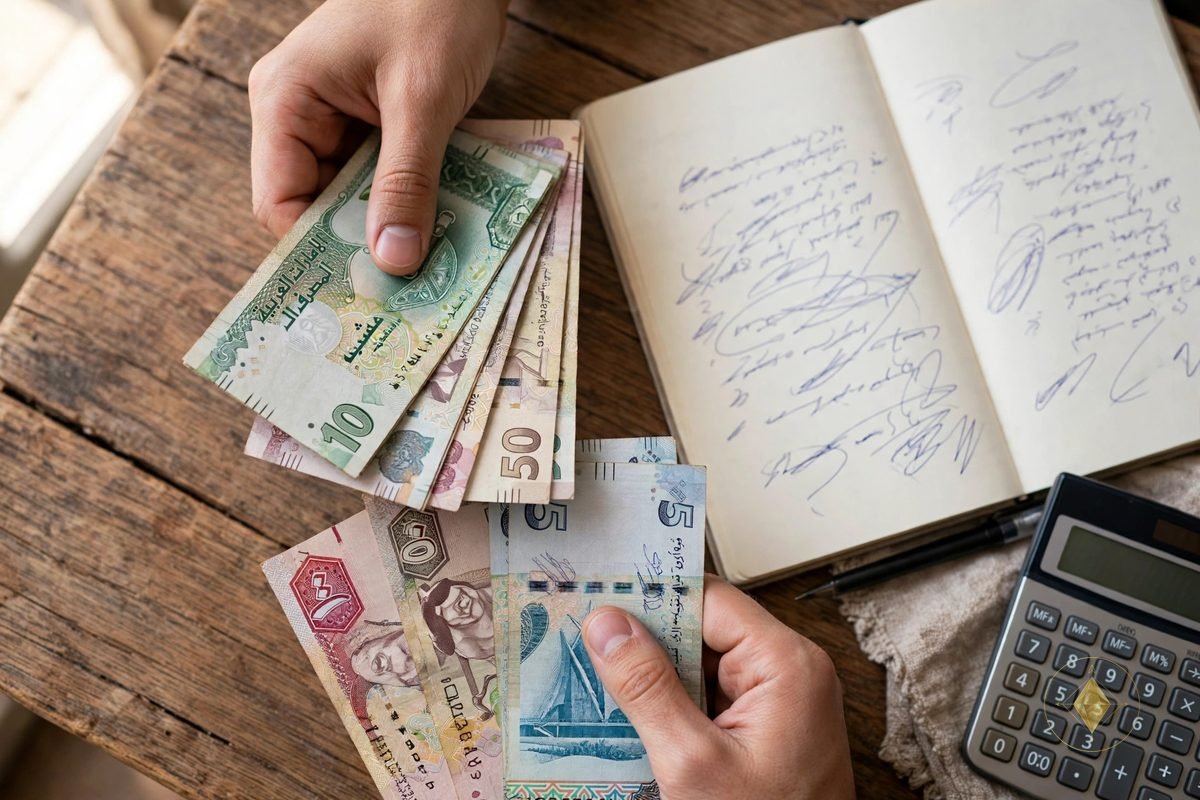
Food is the leak you can change fastest. A cafeteria meal costs AED 15–40; a mall food-court meal for one clusters at AED 30–37; a mid-range dinner for two lands at AED 154–278. One cafeteria meal a day is AED 450–1,200 a month — our own arithmetic. A street karak costs AED 1–3; a global-chain latte costs AED 20 on a delivery platform. Groceries for one person run from AED 500 to AED 2,800 a month across the guides this site fetched, with Property Finder putting the range at AED 800–1,200. The grocery basket item by item is in our groceries guide.

Transport is the smallest of the four. A single metro or bus trip costs AED 3, AED 5 or AED 7.50 depending on zones, on the RTA tariff. Two trips a day, five days a week, at the middle fare is about AED 200 a month — our own arithmetic. The fares are in our transport guide.
Money sent home is the leak most people never count as a cost. Exchange houses charge a flat fee of about AED 5–30 per transfer — Al Ansari Exchange AED 10–30, LuLu Exchange AED 5–25 — plus a margin on the exchange rate of roughly 0.5–1.5%. The World Bank puts the average total cost on the UAE–India corridor at 3.68% in the first quarter of 2025. On a AED 2,000 monthly transfer, 3.68% is about AED 74 — our own arithmetic — and twelve transfers a year at AED 15–25 in fees alone is AED 180–300 before any margin.
Which savings account pays the most in the UAE?
The Central Bank of the UAE held its base rate at 3.90% on 28 October 2026, after raising it from 3.65% on 17 September 2026. The base rate anchors what banks pay savers, and it follows the US Federal Reserve because the dirham is pegged to the dollar. When it moves, savings rates move with it — which is why every rate below carries the date it was read.
| Bank and account | Rate (p.a.) | Conditions | Checked |
|---|---|---|---|
| Emirates NBD Plus Saver | 1.00% to AED 99,999; 1.25% AED 100,000–999,999; 2.75% AED 1m–2,999,999 | Max 5 withdrawals a month, else 0.25%. Promo 5.5% on new money, 1 Oct–31 Dec 2026 | Bank’s own page, live 19 Nov 2026 |
| Emirates NBD Smart S@ver | Up to 1.25% (AED 100,000–1,999,999); 1.00% on AED 25,000–99,999; 0% below AED 25,000 | One withdrawal a month, else 0.25%. Min AED 25,000 to earn | Bank pages, 6 Nov 2026 |
| FAB iSave | 5.60% promo on new funds; standard up to 2.465% below AED 500,000, up to 3.251% AED 500,000–5m | Promo on money above the 31 Aug 2026 balance only, 1 Sep–31 Dec 2026. No minimum, unlimited withdrawals | Bank pages, 6 Nov 2026 |
| ADCB Active Saver | 0.40% to AED 200,000; 1.00% AED 200,000–750,000; 1.75% AED 750,000–2m; 2.25% AED 2m–5m | Tiered by balance; paid monthly | Bank info, 14 Oct 2026 |
| ADCB Super Saver | Up to 5.00% (base 2.25% + bonus 2.75%) — see disagreement below | Bonus on new-to-bank funds only, AED 50,000–20m | Bank pages, Oct–Nov 2026 |
| Mashreq NEO Plus Saver | Up to 6.25% with salary transfer; 5% without | 6.25% needs salary of AED 10,000+ a month; 5% needs AED 50,000+ balance; interest only to AED 500,000; over 2 debits a month, no interest that month | Key Facts Statement, Aug 2026; checked 21 Oct 2026 |
The conditions are the rate: a headline that needs a AED 10,000 salary transfer is a different product from one that needs nothing. Three disagreements are printed, not smoothed. First, ADCB Super Saver: one comparison of bank pages puts it at up to 5.00%, another at up to 4.50% (both base 2.25% plus a bonus, effective 1 May 2026) — check the bank’s page on the day you open the account. Second, ENBD Plus Saver’s promo: 5.5% on new money added between 1 October and 31 December 2026 only, with no stated rate after that date. Third, ENBD’s own two accounts disagree: the Plus Saver pays 1.00% under AED 100,000; the Smart S@ver pays 1.00% only above AED 25,000, nothing below it.
What the money earns, in dirhams — our own simple-interest arithmetic, ignoring compounding:
| Balance | At 1.00% (ENBD Plus Saver) | At 5.05% (best 12-month fixed deposit) | At 6.25% (Mashreq NEO Plus, salary condition) |
|---|---|---|---|
| AED 10,000 | AED 100 a year | AED 505 a year | AED 625 a year |
| AED 50,000 | AED 500 a year | AED 2,525 a year | AED 3,125 a year |
The gap between the first and last columns is the whole story: AED 525 a year on a AED 10,000 balance. But the last column is not free money: it needs a salary of AED 10,000 or more sent to Mashreq every month, it stops paying above AED 500,000, and two withdrawals too many in a month wipes out that month’s interest. Both promo rates — 5.60% and 5.5% — end on 31 December 2026. A rate that ends in six weeks is not a savings plan.
What is National Bonds, and how does it compare with a fixed deposit?
National Bonds is a Sharia-compliant savings and investment company, owned by the Investment Corporation of Dubai and regulated by the UAE Securities and Commodities Authority. It is not a bank and it does not pay interest. Under its Mudarabah structure, your money goes into a Sharia-compliant investment pool, and you receive a share of the profit — declared after the year, not promised before it.
The headline figure: National Bonds declared returns of up to 4.45% for 2025, distributed in early 2026, as announced on 1 April 2026. The year before, the declared figure was 4.0%. The minimum purchase is AED 100 — ten units of AED 10 — and regular savings plans start from AED 100 a month. There is no lock-in on the standard Saving Bonds: money can be taken out after 30 days, though fees can apply to some early redemptions. Savers also enter prize draws, with an annual rewards programme of AED 36 million — a prize is a chance, not a return, and this guide counts none of it as income.
National Bonds also sells Second Salary: at least AED 1,000 a month for 3 to 20 years, at an anticipated 3.25% a year, with the pot then paid back as a monthly income. The 3.25% is anticipated, not declared, and sits below the 4.45% the standard bonds paid for 2025.
A fixed deposit locks the money for a set term at a rate fixed when it is booked. The 12-month rates fetched, all checked in October or early November 2026:
| Bank and product | 12-month rate (p.a.) | Minimum | Checked |
|---|---|---|---|
| DIB Monthly Profit Payment Wakala (Islamic, expected profit) | 5.05% | AED 25,000 | 19 Oct 2026 |
| HSBC Term Deposit (new funds promo) | 4.50% | AED 10,000 | 19 Oct 2026 |
| Wio Fixed Saving Spaces | 4.50% | None | 19 Oct 2026 |
| RAKBANK Fixed Deposit Plus | 4.49% | AED 15,000 | 19 Oct 2026 |
| Emirates NBD fixed deposit | 2.85% | AED 10,000 | 19 Oct 2026 |
| Mashreq fixed deposit | 2.96% | — | 19 Oct 2026 |
A fixed deposit pays more than a standard savings account at the same bank — Emirates NBD pays 2.85% locked for a year against 1.00% in its Plus Saver. National Bonds sits in the middle: its 4.45% for 2025 beats every 12-month fixed deposit fetched except DIB’s 5.05%, and the money stays reachable after 30 days, but the figure is declared afterwards and can fall. A longer lock pays more: Sharjah Islamic Bank’s 36-month deposit pays up to 5.50%, and the government’s Retail T-Sukuk second issue, sold in September 2026, pays 5.06% a year for five years from AED 1,000. Money you may need in the next year does not belong in a fixed deposit.
How big should your emergency fund be?
The standard planning range, repeated across the financial-planning sources fetched for this guide, is three to six months of essential monthly expenses — not three to six months of salary. Essential means the costs that do not stop when income does: rent, groceries, utilities, transport, insurance and minimum debt payments.
Worked from this guide’s own figures: take a single person whose essentials run about AED 4,000 a month — a share of a flat, groceries at the lower end of the published range, metro fares and bills. Three months is AED 12,000; six months is AED 24,000. At AED 1,000 a month saved, three months takes a year to build and six months takes two.
Where you fall in the range depends on how fast you could replace the income. Three months is defensible for a household with two steady incomes and low fixed costs. Six months fits a single earner, someone whose visa depends on the job, or anyone whose next job would take months to find — which describes most expatriates in the UAE.
Build it in order. First, one month of essentials — AED 4,000 in the example above — in an instant-access savings account, not a fixed deposit. Then three months. Then six. The emergency fund comes first because every other kind of saving fails without it: money locked in a 12-month deposit cannot pay next month’s rent. Keep it in a separate account from daily spending, where you can reach it the same day, and refill it before any other saving after you use it. Our savings calculator works out the monthly amount for any target you set.
Should you save in dirhams or send the money home?
The answer is a split, decided by what the money is for. Money for rent, bills and emergencies in the UAE stays in dirhams. Money for family support or a goal back home goes home. The mistake is sending everything home and keeping nothing where you live, or keeping everything here while family waits.
The dirham itself removes one worry. It has been pegged to the US dollar at 3.6725 dirhams per dollar since 1997, and the Central Bank anchors its base rate to the US Federal Reserve’s rate to hold that peg. Saving in dirhams carries no floating-currency risk — the risk sits in the rate you get when you convert.
That conversion is where the cost hides, and it has two parts: the flat fee and the exchange-rate margin. The flat fees are above — about AED 5–30 per transfer at an exchange house, with LuLu Money charging AED 0 on transfers to India through its app under an offer running to 31 March 2027. The margin is the gap between the mid-market rate and the rate you are given, and the World Bank’s figure for the UAE–India corridor is 3.68% total cost in the first quarter of 2025. One live comparison from early November 2026: sending AED 25,000 to India cost an AED 227.58 fee through one app and delivered about ₹6,31,048, while another service charged AED 5 and delivered about ₹6,38,750. The ranking flips by day and amount — compare on the amount received, never the advertised fee. Remittance fees in the UAE also carry 5% VAT, which a genuinely free transfer avoids.
Three working rules. First, send less often and in larger amounts: one transfer of AED 4,000 usually beats four transfers of AED 1,000, because the flat fee is charged per transfer. Second, keep the emergency fund in dirhams — it is for a crisis here, and converting it twice loses money both ways. Third, compare providers on the amount received for your exact amount and corridor, on the day you send, and use only providers licensed by the Central Bank. The full cost of living is worked through in our cost of living guide, and the method behind every salary figure on this site is on the How We Calculate Salaries page.
How do you start saving this month?
- Move the money on payday, not at month end. Set a standing instruction to move your chosen amount into a separate savings account the day the salary lands. What stays in the current account gets spent; what leaves on payday gets saved.
- Pick one leak and close it for a month. One cafeteria meal a day at AED 15–40 is AED 450–1,200 a month, and a food-court lunch at AED 30–37 costs roughly double. Cook five lunches a week for one month and count what is left.
- Build the emergency fund before locking anything away. One month of essentials first, in an account you can reach the same day. Fixed deposits and National Bonds’ longer plans come after the fund, not before it.
- Match the account to the money. Money you may need this month sits in a plain savings account. Money you will not need for a year goes into a fixed deposit or National Bonds. Money you will not need for five years is the only money that belongs in a five-year T-Sukuk. Check the rate on the bank’s own page on the day you open the account.
- Count the saving in dirhams, not percentages. AED 1,000 a month is AED 12,000 in a year — the figure that pays the next rent cheque, the next flight home, or the first month without a job.
FAQs
What is a good savings rate in the UAE?
There is no published average, so judge it against your own costs. On the salaries this site publishes, 10% is AED 400–894 a month and 20% is AED 800–1,787 a month. The 50/30/20 method sets 20% as the savings share, but on a AED 4,000–5,000 salary the rent figures show 20% is only reachable with shared housing. A rate you can hold every month beats a higher rate you abandon in month two.
Can I open a savings account without a salary transfer?
Yes, for most accounts on this page. FAB iSave has no minimum balance and no salary requirement, and its standard rate runs up to 2.465% below AED 500,000. Emirates NBD’s Plus Saver has no salary requirement either, paying 1.00% under AED 100,000. The highest rate fetched, Mashreq NEO Plus at 6.25%, is the exception: it needs a salary transfer of AED 10,000 or more a month, and without it pays 5% on balances of AED 50,000 or more.
Is National Bonds halal?
National Bonds describes itself as Sharia-compliant: it invests through a Mudarabah profit-sharing structure, pays a share of profit rather than interest, and is overseen by a Shariah Supervisory Board. It is owned by the Investment Corporation of Dubai and regulated by the UAE Securities and Commodities Authority. Its declared return for 2025 was up to 4.45% — a declared profit share, not a guaranteed rate.
How much should I save each month on AED 5,000?
At 20%, AED 1,000 a month, or AED 12,000 in a year. At 10%, AED 500 a month, or AED 6,000 in a year. But the rent figures matter more than the percentage: a studio averages about AED 3,417 a month, more than the whole 50% needs bucket of a AED 5,000 salary. If the rent does not fit the method, change the housing before chasing the percentage.
Is it better to keep savings in AED or send them home?
Keep in dirhams whatever covers life in the UAE — rent, bills and the emergency fund — because the dirham is pegged to the dollar at 3.6725. Send home what is for family or a goal there, in fewer and larger transfers, and compare providers on the amount received: exchange houses charge about AED 5–30 per transfer plus a rate margin, and the World Bank puts the average total cost on the UAE–India corridor at 3.68%.
Data sources used on this page:
- Emirates NBD — Plus Saver Account (bank’s own page, tier table effective 1 February 2026; 5.5% new-money offer 1 Oct–31 Dec 2026) — https://www.emiratesnbd.com/en/accounts/savings-accounts/plus-saver-account — opened live 19 November 2026
- InvestingInTheWeb — Highest yield savings accounts in Dubai and UAE in 2026 (ENBD Smart S@ver tiers; FAB iSave 5.60% promo and standard tiers) — https://investingintheweb.com/brokers/best-savings-accounts-uae/ — rates checked 6 November 2026, retrieved 19 November 2026
- StashAway — Best Savings Accounts in UAE (Nov 2026) (FAB iSave standard tiers) — https://www.stashaway.ae/r/best-high-yield-interest-savings-account-uae — rates checked 2 November 2026, retrieved 19 November 2026
- Madena — Mashreq NEO Savings Account (NEO Plus Saver 6.25% salary / 5% non-salary, AED 50,000 balance, 2-debit rule; Key Facts Statement August 2026) — https://www.madena.ae/banking/accounts/mashreq-neo-savings-account — updated 21 October 2026, retrieved 19 November 2026
- WhatMatters — Best Savings Accounts in UAE 2026 (ADCB Active Saver tiers 0.40%–2.25%) — https://www.whatmatters.ae/post/best-savings-accounts-uae-2026-profit-rates-minimum — official bank information reviewed 14 October 2026, retrieved 19 November 2026
- BrokerMatch — Best high-yield savings accounts in Dubai & UAE for 2026 (ADCB Super Saver up to 5.00%: base 2.25% + bonus 2.75%) — https://www.brokermatch.ae/articles/best-savings-accounts-uae — retrieved 19 November 2026
- MoneySaverWorld — 5 Best Savings Accounts In UAE (2026) (ADCB Super Saver up to 4.50%: base 2.25% + bonus 2.25%, effective 1 May 2026; Mashreq NEO Plus terms) — https://moneysaverworld.com/top-saving-accounts-in-uae/ — retrieved 19 November 2026
- National Bonds results announcement via Emirates News Agency / OneVille News — returns up to 4.45% distributed to savers in 2025; funds above AED 18 billion — https://onevillenews.com/2026/04/01/uae-economic-resilience-drives-record-savings-growth/ — published 1 April 2026, retrieved 19 November 2026
- HalalWallet — Second Salary Review 2026 (National Bonds Second Salary: AED 1,000/month minimum, 3–20 year term, 3.25% anticipated) — https://www.halalwallet.ae/blog/national-bonds-second-salary-review-2026 — retrieved 19 November 2026
- PolicyBazaar.ae — National Bonds UAE 2026 (Saving Bonds 4.45% for 2025; 4.0% for 2024; minimum AED 100) — https://www.policybazaar.ae/investment-plans/articles/national-bonds-uae/ — retrieved 19 November 2026
- StashAway — Best Fixed Deposit Rates in UAE (Nov 2026) (DIB 5.05%, HSBC 4.50%, Wio 4.50%, RAKBANK 4.49%, ENBD 2.85%, SIB 5.50% at 36 months) — https://www.stashaway.ae/r/best-fixed-deposit-rates-uae — as of 3 November 2026, retrieved 19 November 2026
- BrokerMatch — Fixed deposit rates in the UAE (Oct 2026) (12-month table checked 19 October 2026; DIB 5.05% expected, ENBD 2.85%, Mashreq 2.96%) — https://www.brokermatch.ae/articles/fixed-deposit-rates-uae — retrieved 19 November 2026
- BrokerMatch — UAE Retail T-Sukuk (2nd issue September 2026: 5.06% a year, 5 years, AED 1,000 minimum; 1st issue June 2026: 4.30%, 2 years) — https://www.brokermatch.ae/articles/uae-retail-t-sukuk — retrieved 19 November 2026
- Central Bank of the UAE base rate 3.90% (raised from 3.65% on 17 September 2026, held 28 October 2026) — via WayzFinder, UAE Mortgage Rates November 2026 — https://www.wayzfinder.com/news-uae-mortgage-rate-update-november-2026 — retrieved 19 November 2026; also SwankDevelopment — https://swankdevelopment.com/uae-mortgage-rates/
- World Bank remittance prices — UAE–India corridor average total cost 3.68% (Q1 2025), 0.72% exchange-rate margin — via Mint2Save — https://www.mint2save.com/cheapest-way-to-send-money-to-india-uae-us-uk/ — retrieved 19 November 2026
- Finatune — Cheapest Way to Send Money from UAE 2026 (Al Ansari AED 10–30 flat fee, 0.5–1.5% margin; LuLu AED 5–25, 0.5–1% margin) — https://www.finatune.com/en/blog/cheapest-way-send-money-uae-2026 — retrieved 19 November 2026
- 50/30/20 method — Elizabeth Warren and Amelia Warren Tyagi, All Your Worth: The Ultimate Lifetime Money Plan (2005) — via Ramsey Solutions — https://www.ramseysolutions.com/budgeting/50-20-30-budget-rule — retrieved 19 November 2026
- Emergency fund 3–6 months of essential expenses — standard planning range — via FinCalWise — https://fincalwise.com/blog/how-much-should-you-have-in-an-emergency-fund — retrieved 19 November 2026
- SalarySouq own published guides (figures retrieved 23 October 2026 for those guides; restated here as anchors): Paramedic salary guide (average AED 8,936, range AED 4,824–16,554, Indeed UAE n=33); Payroll Officer salary guide (average AED 4,873, range AED 2,288–10,376, Indeed UAE n=57); Personal Driver salary guide (average AED 4,000, range AED 3,000–5,500, GulfTalent n=59); Rent guide (studio AED 41,000/year, 1-bed AED 61,000/year, Bayut H1 2026; Property Finder studio AED 32,000/year); Groceries guide (single person AED 500–2,800/month across guides; Property Finder AED 800–1,200); Street food guide (cafeteria meal AED 15–40; karak AED 1–3); Eating out guide (food-court meal AED 30–37; dinner for two AED 154–278; latte AED 20); Transport guide (Nol fares AED 3 / 5 / 7.50, RTA tariff)
Methodology: every rate and figure on this page was retrieved on 19 November 2026 unless the source line says otherwise. Savings-account and fixed-deposit rates are the banks’ published rates as read on the dates shown; promotional rates are labelled as promotions with their end dates, and standard rates are shown beside them. Where comparison sources disagree — ADCB Super Saver at 5.00% versus 4.50% — both figures are printed. Salary anchors are SalarySouq’s own published guides, restated with their sources. Tables marked as our own arithmetic are simple multiplication of published figures (salary × percentage, balance × rate, daily cost × 30) and are labelled as such. No average UAE savings rate is quoted anywhere on this page because no source fetched publishes one. This guide is general information, not personal financial advice; confirm every rate on the bank’s own page before opening an account.