
Last updated: 23 October 2026
Rent is the biggest monthly cost in Dubai, and the price of the same size of apartment changes a lot by area. A studio in International City and a studio in Dubai Marina can differ by more than AED 30,000 a year. This guide sets out what studios and 1-bedroom apartments actually cost across 12 Dubai areas in 2026, what you pay on top of the rent, and what salary those rents require.
One point on the numbers before you use them. Most figures below are asking rents — the prices landlords advertise, taken mainly from Bayut listings data (averages of listings from the past six months) and Bayut’s H1 2026 rental report. Where a figure comes from signed contracts instead, such as Dubai Land Department (DLD) transaction data, it is labelled as a contracted rent. Contracted rents usually sit below asking rents: in Dubai Silicon Oasis, for example, studios actually contracted at an average of AED 40,865 a year over the last 12 months (DLD data via Bayut TruView), against an asking average of AED 46,301.
How much is a studio apartment in Dubai per month?
A studio in Dubai costs roughly AED 3,300 to AED 6,200 a month in the 12 areas covered here — AED 40,000 to AED 74,000 a year (Bayut listings data and Bayut H1 2026 report, October 2026).
The cheapest studios are in Deira (about AED 40,239 a year, or AED 3,353 a month), International City (AED 41,000 a year) and Al Nahda (AED 41,889 a year). At the top end, Dubai Marina studios average AED 74,296 a year (AED 6,191 a month) and Business Bay AED 64,000–73,000 a year, depending on the source. The full area-by-area table is in the third section below.
What pushes a single studio above or below its area average is the building: age, maintenance, whether cooling is included, and how many cheques the landlord wants. Two studios on the same street can be AED 5,000 a year apart for those reasons alone.
How much is a 1-bedroom apartment in Dubai per month?
A 1-bedroom apartment in Dubai costs roughly AED 4,500 to AED 8,500 a month across these 12 areas — AED 54,000 to AED 102,000 a year (Bayut listings data and Property Finder guides, October 2026).
Al Nahda has the lowest 1-bedroom average here, AED 54,361 a year (AED 4,530 a month). International City follows at AED 61,000 a year. Dubai Marina (AED 101,785 a year) and Business Bay (AED 99,000–104,000 a year) are the most expensive of the twelve.
Note the jump between a studio and a 1-bedroom is not uniform. In Al Nahda it is about AED 12,500 a year. In Deira it is nearly AED 30,000 a year (AED 40,239 studio average against AED 69,933 for a 1-bedroom), because Deira’s 1-bedroom stock includes a lot of larger, older units. If you are choosing between a big studio and a small 1-bedroom, compare actual units, not area averages.
Which areas of Dubai have the cheapest rent in 2026?
The cheapest areas in this group are International City, Deira and Al Nahda for studios, and Al Nahda, International City and Dubai Silicon Oasis for 1-bedroom apartments.
The table below gives the average for each area. Figures are annual rent with the monthly equivalent in brackets. Unless marked otherwise, they are asking rents from Bayut listings data (past six months) or the Bayut H1 2026 rental report, checked October 2026.
| Area | Studio (AED/year) | 1-bedroom (AED/year) | Basis |
|---|---|---|---|
| International City | 41,000 (3,417/mo) | 61,000 (5,083/mo) | Bayut H1 2026 report |
| Deira | 40,239 (3,353/mo) | 69,933 (5,828/mo) | Bayut listings average |
| Al Nahda | 41,889 (3,491/mo) | 54,361 (4,530/mo) | Bayut listings average |
| Dubai Silicon Oasis | 46,301 (3,858/mo) | 64,296 (5,358/mo) | Bayut listings average |
| Discovery Gardens | 47,000–49,000 (3,917–4,083/mo) | 69,000–70,000 (5,750–5,833/mo) | Bayut, by cluster |
| Dubai Sports City | 44,795 (3,733/mo) | 66,069 (5,506/mo) | Bayut listings average |
| Jumeirah Village Circle (JVC) | 51,207 (4,267/mo) | 75,541 (6,295/mo) | Bayut listings average |
| Bur Dubai | 52,000 (4,333/mo) | 78,000–98,000 (6,500–8,167/mo) | MyBayut / Property Finder (see note) |
| Al Barsha | 50,000–59,000 (4,167–4,917/mo) | 70,000–86,000 (5,833–7,167/mo) | Property Finder guide |
| Jumeirah Lake Towers (JLT) | 62,690 (5,224/mo) | 89,748 (7,479/mo) | Bayut listings average |
| Business Bay | 64,000–73,000 (5,333–6,083/mo) | 99,000–104,000 (8,250–8,667/mo) | dubizzle / Bayut H1 2026 report |
| Dubai Marina | 74,296 (6,191/mo) | 101,785 (8,482/mo) | Bayut listings average |
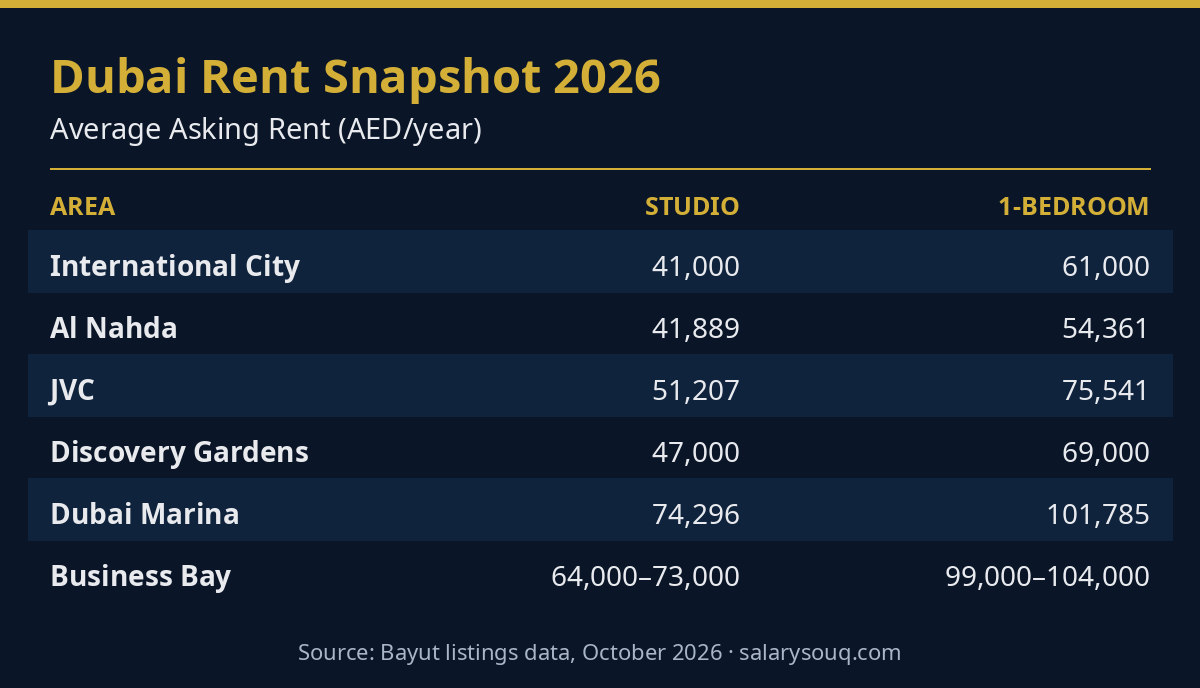
Two areas need a warning. Bur Dubai’s 1-bedroom figures disagree more than any other area in this guide: MyBayut’s area table puts the average at AED 78,000 a year, while Property Finder, using DLD market data, puts it at AED 98,000. Both can be true because the stock is split — older 1-bedrooms in Golden Sands start from about AED 53,000 a year, while new buildings in Al Kifaf run AED 95,000–110,000 (Property Finder). Treat Bur Dubai as a wide range and price the specific building. Al Barsha figures come from a single source (Property Finder’s guide); no Bayut listings average broken down by unit size was available, so hold those numbers as a range too.
Also keep in mind that asking is not the same as contracted. Property Finder’s International City averages, which are based on recent contracts including renewals, are AED 32,000 for a studio and AED 45,000 for a 1-bedroom — well below the asking averages above. Long-standing tenants renewing under the DLD rental index often pay less than new tenants signing at asking prices.
What extra costs come on top of rent in Dubai?
Budget for five extra costs: Ejari registration (AED 177.75 online), agency commission (typically 5% of annual rent), the landlord’s security deposit (5% of annual rent unfurnished, 10% furnished), the DEWA deposit (AED 2,000 for an apartment), and the municipal housing fee (5% of annual rent, billed monthly through DEWA).
- Ejari. Registering your tenancy contract costs AED 177.75 if you do it online through the Dubai REST app or DLD website (Dubai Land Department fee schedule). At a Real Estate Services Trustee Centre the same registration costs AED 220. It is a one-off fee per contract.
- Agency commission. If an agent handled the letting, the standard commission is 5% of the annual rent, often with a minimum of around AED 3,000–5,000 (Dubai Residential; Curly Tales). It is negotiable, and it is paid once, not yearly — though a new fee usually applies if you move.
- Security deposit to the landlord. 5% of annual rent for an unfurnished unit, 10% for furnished (Dubai Standard, corroborated by Property Finder). Refundable at the end of the tenancy, subject to the condition of the unit.
- DEWA deposit and activation. The security deposit for electricity and water is AED 2,000 for an apartment and AED 4,000 for a villa, plus AED 155 in activation charges for a small meter — AED 2,155 total for an apartment (DEWA fee schedule). The deposit is refundable when you close the account.
- Housing fee. Dubai Municipality charges 5% of your annual rent, collected in 12 monthly instalments inside your DEWA bill. On AED 60,000 rent that is AED 3,000 a year, about AED 250 a month. It is not optional and it is not part of the rent cheque.
On a AED 60,000 unfurnished apartment found through an agent, the move-in bill before your first rent cheque is roughly AED 8,300: AED 3,000 agency commission, AED 3,000 landlord deposit, AED 2,155 DEWA, and AED 178 Ejari. That arithmetic uses the official fees above — check your own figures the same way before you sign.
Is chiller included in the rent, and why does it change the real cost?
Sometimes. In buildings with district cooling (Empower or Emicool), the tenant normally pays a separate monthly cooling bill on top of rent — typically AED 410–510 a month for a 1-bedroom on Empower’s tariff, and more in summer. In “chiller-free” buildings the landlord covers cooling, so the rent is the full housing cost.
This changes comparisons. A AED 66,000 1-bedroom in a district-cooling tower in Dubai Sports City (Emicool; typical bill AED 400–750 a month in summer, AED 200–320 in winter — Dubai Property Insight) can cost more over a year than a AED 70,000 chiller-free unit in JVC, where chiller-free buildings are common. Dubai Marina, JLT and Business Bay are Empower areas where the tenant usually pays; typical 1-bedroom cooling bills run AED 450–900 a month in summer and AED 220–400 in winter in those areas. International City has no district cooling — air conditioning runs through your DEWA bill (about AED 300–600 extra in summer). Discovery Gardens listings are frequently advertised as chiller free.
District cooling also has its own move-in deposit, and sources differ on it: MyBayut states AED 2,000 for a flat, while Property Finder’s blog lists AED 1,500 for a 1-bedroom. The consumption charge is quoted at AED 0.568 per RT-hour by MyBayut and AED 0.62 per ton-hour by Property Finder. Your Cooling Service Agreement sets your actual rates — read it before signing, because a “cheap” rent with tenant-paid cooling is a common way listings mislead. Cooling arrangements are set building by building, so always confirm for the exact tower.

How many cheques should you pay with — and does it change the price?
Yes, it changes the price. The fewer cheques you pay with, the lower the annual rent you can usually negotiate — and no law requires a landlord to charge the same rent for 12 cheques as for 1.
Dubai Residential (Nakheel’s leasing arm) states it plainly: tenants paying with fewer cheques can often negotiate a lower annual rent, while 12 cheques can mean a slightly higher one — it even gives one-cheque payers 2% cashback on its own communities. One worked example in the market shows the same unit quoted at AED 95,000 a year in 4 cheques against AED 90,000 in 1 cheque, a 5.3% difference (Masrofna). Market commentary puts the typical uplift for 6–12 cheques at around 5–10% (Dubai Property News) — that is commentary, not an official tariff, so treat it as negotiating room, not a fixed rule.
Payment schedules on published price lists show what is actually offered: Dubai Residential lists 1, 2 or 4 payments for International City and 1, 2, 4 or 6 for Discovery Gardens. Market-wide, single-cheque contracts fell from 29% to 26% of agreements in H1 2026 while 3-, 6- and 12-cheque deals all grew (betterhomes) — landlords are accepting more cheques, but the discount for paying in fewer instalments is still there to ask for.
What salary do you need to afford a 1-bedroom in Dubai?
Use the 30% rule: keep annual rent at or under 30% of your annual salary (a rule of thumb stated by Bayut, Property Finder and dubizzle — budgeting guidance, not law). On that basis, a 1-bedroom at AED 60,000 a year needs a salary of about AED 16,700 a month; at AED 75,000 a year, about AED 20,800 a month; at AED 90,000, about AED 25,000 a month; and at AED 103,000 — Business Bay and Marina territory — about AED 28,600 a month.
Worked against the areas in this guide: the Al Nahda 1-bedroom average (AED 54,361) fits a salary of roughly AED 15,100 a month under the rule. Dubai Silicon Oasis (AED 64,296) needs about AED 17,900. JVC (AED 75,541) needs about AED 21,000. JLT (AED 89,748) needs about AED 24,900.
To place that against real pay, check the salary guides on this site for the jobs you are comparing — driver salaries in Dubai, registered nurse salaries and teacher salaries — then run your own numbers in the Savings Calculator to see what is left after rent. Our methodology page explains how we calculate salaries and the data behind them.
Two cautions on the 30% rule. First, it counts rent only — add the housing fee, DEWA and cooling from the sections above and the true housing share is several points higher. Second, if your employer provides accommodation or a housing allowance, the maths changes completely; many UAE contracts in driving, nursing and hospitality include one or the other, which is why the salary guides separate basic pay from allowances.
One final protection worth knowing before you sign: at renewal, rent increases are capped by the DLD Smart Rental Index under Decree 43 of 2013. If your rent is up to 10% below the index average for similar units, no increase is allowed; the cap rises in bands to a maximum of 20% when your rent is more than 40% below average. Your landlord must also give written notice at least 90 days before the contract expires. The index is a per-building lookup in the Dubai REST app — there is no published per-area index table, so check your own building rather than relying on area averages.
Sources: Bayut listings data and Dubai Rental Market Report H1 2026 (bayut.com); dubizzle area guides and blog (dubizzle.com); Property Finder community guides and blog (propertyfinder.ae); Dubai Land Department fee schedule and Smart Rental Index (Decree 43 of 2013); DEWA fee schedule; Dubai Residential published price lists 2026 (dubairesidential.ae); Empower tariff as published by MyBayut. Figures were pulled on 23 October 2026. Asking rents are advertised prices; contracted rents from DLD transaction data are labelled where used.