

“Is the metro cheap?” is the wrong question — at AED 3 to 7.50 a journey, of course it is. The question that matters when you are weighing a job offer or a lease is what a whole month of moving around Dubai costs under each way of doing it: a Nol pass, taxis, your own car, or a rental. This guide prices all four from the tariffs the operators themselves publish — RTA’s Nol fare tables and Dubai Taxi Company’s meter rates, pulled in October 2026 — and then builds the monthly totals side by side. Where a monthly figure needs a trip count or a distance, that assumption is ours, and it is printed next to the total it produces.
How much does the metro and bus cost in Dubai?
On a Silver Nol card, a metro or bus journey costs AED 3 within one zone, AED 5 across two zones and AED 7.50 across more than two (RTA). The 30-day pass costs AED 140 for one zone, AED 230 for two zones and AED 350 for all zones. And here is the finding most guides skip: at two zones, the AED 230 pass only breaks even at 46 journeys a month. A plain commute — two trips a day on 22 working days — is 44 journeys, AED 220 pay-as-you-go. The pass is not the cheapest way to commute; it is the predictable one, and it wins the moment you add any weekend or evening travel on top.
| Card | 1 zone | 2 zones | More than 2 zones |
|---|---|---|---|
| Silver Nol | AED 3 | AED 5 | AED 7.50 |
| Gold Nol (Gold Class) | AED 6 | AED 10 | AED 15 |
| Red Ticket | AED 4 | AED 6 | AED 8.50 |
The cards themselves: a Silver card is AED 25 including AED 19 of balance, and a Gold card is the same price (RTA). A personal (Blue) card is AED 70 including AED 20 — and you need the registered personal card for the longer passes, because an anonymous Silver card can only hold the 7-day pass (AED 50 / 80 / 110). The 90-day pass runs AED 330 / 550 / 830 and the annual AED 1,060 / 1,770 / 2,670. Students and senior residents ride at half fare on a personal card, and children under five ride free.
A change of vehicle is not a second fare. Check in on the next mode within 30 minutes of checking out of the previous one and the trips count as a single journey, charged once on the combined zones crossed — up to 3 transfers inside a 180-minute limit. The tram sits entirely inside Zone 2, so a tram-only trip is AED 3 on Silver. Keep at least AED 7.50 on the card: that is the minimum balance the metro gates require.
Hours set the other limit. The metro runs Monday to Thursday and Saturday 05:00 to midnight, Friday 05:00 to 01:00, and Sunday 08:00 to midnight (RTA Timetable). Buses run 04:00 to 01:00 across the network on the same zone fares, and one route — the C01 — runs 24 hours. The AED 230 two-zone pass is the transport line used in all three budgets in our cost of living in Dubai guide; this section is the working behind that line.
How much do taxis cost in Dubai in 2026?
A street-hailed taxi starts at AED 5.00 by day (06:00–22:00) and AED 5.50 at night, then runs at AED 2.45 per kilometre, with a AED 12 minimum fare (Dubai Taxi Company — DTC, the RTA-regulated operator — October 2026). Waiting time is charged at AED 0.50 a minute, and any Salik tolls on your route are added to the meter.
That per-kilometre rate is the number to watch, and the one older guides get wrong. It is indexed to fuel prices and adjusts monthly: through late 2025 it sat at AED 2.14–2.26 a kilometre (Gulf News, reporting RTA), and at October 2026 fuel prices it is AED 2.45. Any taxi total quoted from an older rate is priced on a dead number — at the commute pattern in the comparison below, the rise alone adds roughly AED 63–109 a month.
Book through an app instead — Hala on Careem, S’hail or Bolt — and the starting fare, flagfall and booking fee combined, is AED 9 off-peak, AED 10 at night and AED 13 at peak, with a AED 13 minimum fare (DTC; Hala publishes the same figures). The meter after that is identical: AED 2.45 a kilometre, AED 0.50 a minute. Airport taxis run on their own tariff — flagfall AED 20 for a car, AED 25 for a van, AED 2.62 a kilometre — and are priced route by route in the airport section below.
One plain statement, because guide sites blur it: Careem’s private cars and Uber publish no official Dubai tariff. Both price each trip inside the app, and the per-kilometre “rate cards” quoted around the web are not published tariffs — the three we checked give three different per-kilometre figures for the same Careem tier, so none of them is used in this guide. The only app-booked cars with a published tariff are the RTA taxis above.
What does it cost to drive your own car in Dubai?
Start with the one-off cost of getting legal, then the stack that repeats. Converting an eligible foreign licence costs AED 1,010–1,050 all-in — file opening AED 200, licence issuance AED 600, handbook AED 50, eye test AED 140–180 and a AED 20 Knowledge & Innovation fee, on RTA’s fees as itemised by Gulf News. A first licence from scratch runs AED 4,500–6,500 passing first time, on a guide synthesis of the major schools’ published packages, and AED 7,000–10,000 or more once retakes land.
Petrol is the line that moved this month. Special 95 is AED 4.28 a litre for October 2026 (UAE Fuel Price Committee, reported by Gulf News, Khaleej Times and WAM) — up 16% on September’s AED 3.69. Super 98 is AED 4.40 and diesel AED 4.80. That single jump is why the taxi meter in the previous section is at AED 2.45, and it adds about AED 71 a month to the fuel line of the worked car budget below.
Salik comes next. The tag costs AED 102.50 at an authorised agent, or AED 122.50 online, and includes AED 50 of toll credit. Crossings are AED 6 at peak (Monday–Saturday 06:00–10:00 and 16:00–20:00) and AED 4 off-peak on the Dubai Government portal’s tariff, free between 01:00 and 06:00 — but since June 2026 the amount actually deducted carries 5% VAT, so AED 6.30 and AED 4.20 leave your account. The shape of it: two gates each way at peak over 22 working days is AED 554.40 a month (YallaMotor’s worked example) — tolls alone can top the fuel bill.
Parking is Parkin’s. Paid hours run Monday to Saturday, 08:00 to 22:00, with Sundays and public holidays free; standard zones charge AED 4 an hour at peak and premium zones AED 6, on base tariffs that have also carried 5% VAT since June 2026. If you park at work every day, a seasonal permit beats the meter: Category B areas (zones B and D) are AED 250 a month before VAT, Category A (zones A–D) AED 500.
The annual lines, spread out: registration renewal is AED 560 a year all-in (AED 350 renewal, AED 170 test, the rest fees and delivery); insurance starts from AED 600 a year for third-party cover and from AED 1,350 for comprehensive (Lookinsure, October 2026); servicing at an independent garage runs AED 1,200–2,600 a year. None of these is large alone. Stacked on fuel, tolls and parking, they are the comparison in the next section.
Metro pass, taxi, own car or rental — which is cheapest per month?
The Nol pass, and not close — it costs roughly a fifth of the next cheapest way of commuting. Side by side for one commuter: a two-zone pass is AED 230; a taxi commute is AED 1,082–1,434; running your own car is about AED 1,590–1,706 on a tolled route, or AED 1,035–1,152 if your route crosses no Salik gates; a rental, all-in, is about AED 2,156–2,767.
| Way of getting around | AED/month | What the figure covers |
|---|---|---|
| Nol 30-day pass, 2 zones | 230 | Unlimited metro, bus and tram across 2 zones |
| Own car, no-Salik route | ≈1,035–1,152 | Running costs only — fuel, permit parking, insurance, registration, servicing |
| Taxi commute, street-hail | ≈1,082 | 44 trips of 8 km at the DTC meter |
| Own car, Salik route | ≈1,590–1,706 | The same running costs plus peak tolls |
| Rental car, all-in | ≈2,156–2,767 | Basic-sedan rent plus the same fuel and tolls |
Every assumption behind those totals is ours, printed here so you can re-run them on your own pattern. The taxi figure is two trips a day on 22 working days, 8 km a trip, street-hail by day (AED 5.00 + 8 × 2.45 = AED 24.60 a trip); book the same trips in an app at peak and the month rises to AED 1,434. The own-car figure is 1,500 km a month at 8.0 litres per 100 km — 120 litres at AED 4.28 is AED 513.60 of fuel — plus four peak Salik crossings a day, work-end parking on the cheapest sourced permit (Category B at AED 262.50 with VAT), comprehensive insurance at the lowest sourced starting price, and registration and servicing spread monthly. The car’s purchase price or loan is excluded: owning starts behind before this comparison begins. The rental figure is listed basic-sedan rents of AED 1,088–1,699 a month (the cheapest verified listing, a 2025 Nissan Sunny via dubizzle, to a Sunny on eZhire’s own site) plus the same fuel and tolls, with insurance inside the rent where the listing states it.
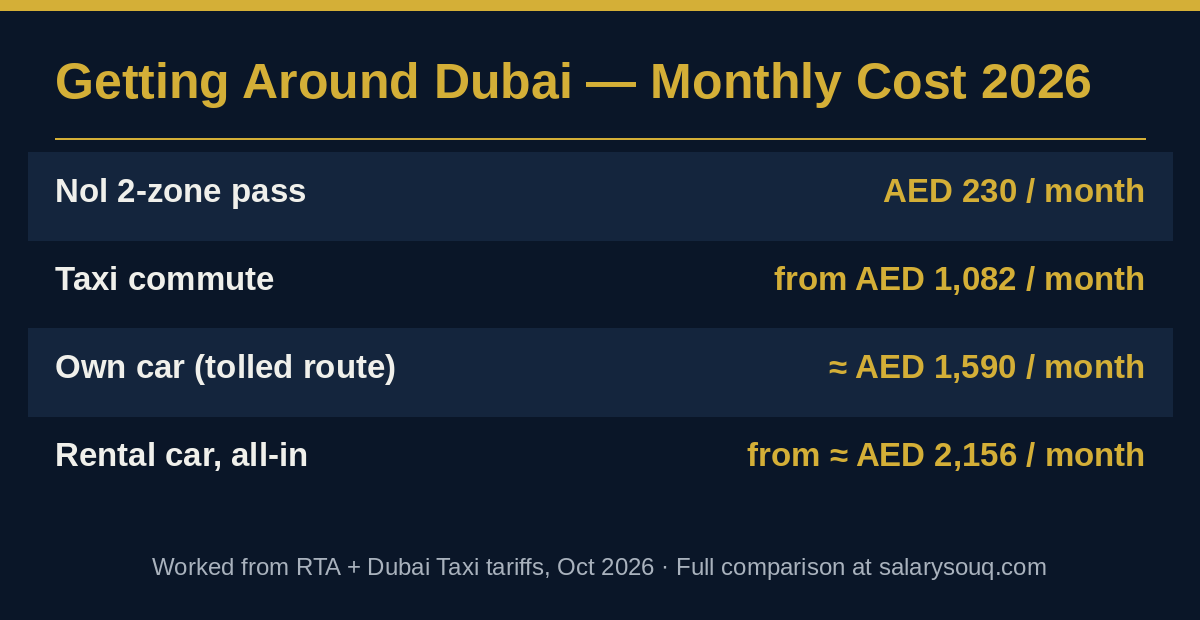
Two things stand out from the table. First, taxis for a fixed commute (AED 1,082 street-hail) cost less per month than running your own car on a tolled route (AED 1,590–1,706) — before the car’s purchase price is counted at all. Second, the crossover is pattern, not price: a taxi charges per trip and a car charges whether it moves or not, so every day the car sits parked, owning looks worse. The biggest lever after the choice itself is the route — Salik is a third of the tolled own-car total.
The decision underneath all five rows is where you live. A flat inside a two-zone metro commute keeps you on the AED 230 row; a cheaper flat off the network quietly moves you into a car row — the same address decision that sets your grocery options and prices. Set whichever transport row you land on against rent and food in our cost of living in Dubai budgets, where AED 230 is the transport line in all three.
How much does it cost to get from Dubai Airport (DXB) to the city?
By metro, AED 3 to Deira, AED 5 to Bur Dubai or Downtown, and AED 7.50 to the Marina — the airport stations sit in Zone 5, and the fare is simply the zone count from there. By taxi, on the airport tariff (flagfall AED 20 for a car, AED 25 for a van, plus AED 2.62 a kilometre — DTC), published estimates put Deira at about AED 35 and Downtown at about AED 53. Each estimate sits a little below a straight meter computation — AED 38.34 and AED 59.30 respectively — because real trips vary with route, waiting time at AED 0.50 a minute, and any Salik on the way.
| Area | Distance | Metro (Silver Nol) | Taxi (published estimate) |
|---|---|---|---|
| Deira / Baniyas Square | ~7 km | AED 3 | ~AED 35 |
| Bur Dubai / Al Fahidi | ~10 km | AED 5 | ~AED 42 |
| Downtown / Dubai Mall | ~15 km | AED 5 | ~AED 53 |
| Dubai Marina / JBR | ~33 km | AED 7.50 | A range — see below |
The Marina is the one route where the published numbers refuse to agree, and this guide is not going to pick one. Gulf News puts the trip at AED 60–70, but on a stated distance of 20 km that does not match the route. Welcome Pickups puts it at AED 92 on 33 km, and the straight meter computation on that distance — AED 20 + 33 × 2.62 — gives AED 106.46. Plan the Marina run as a range of roughly AED 90–110 at the real distance, and treat any single neat figure for it with suspicion.
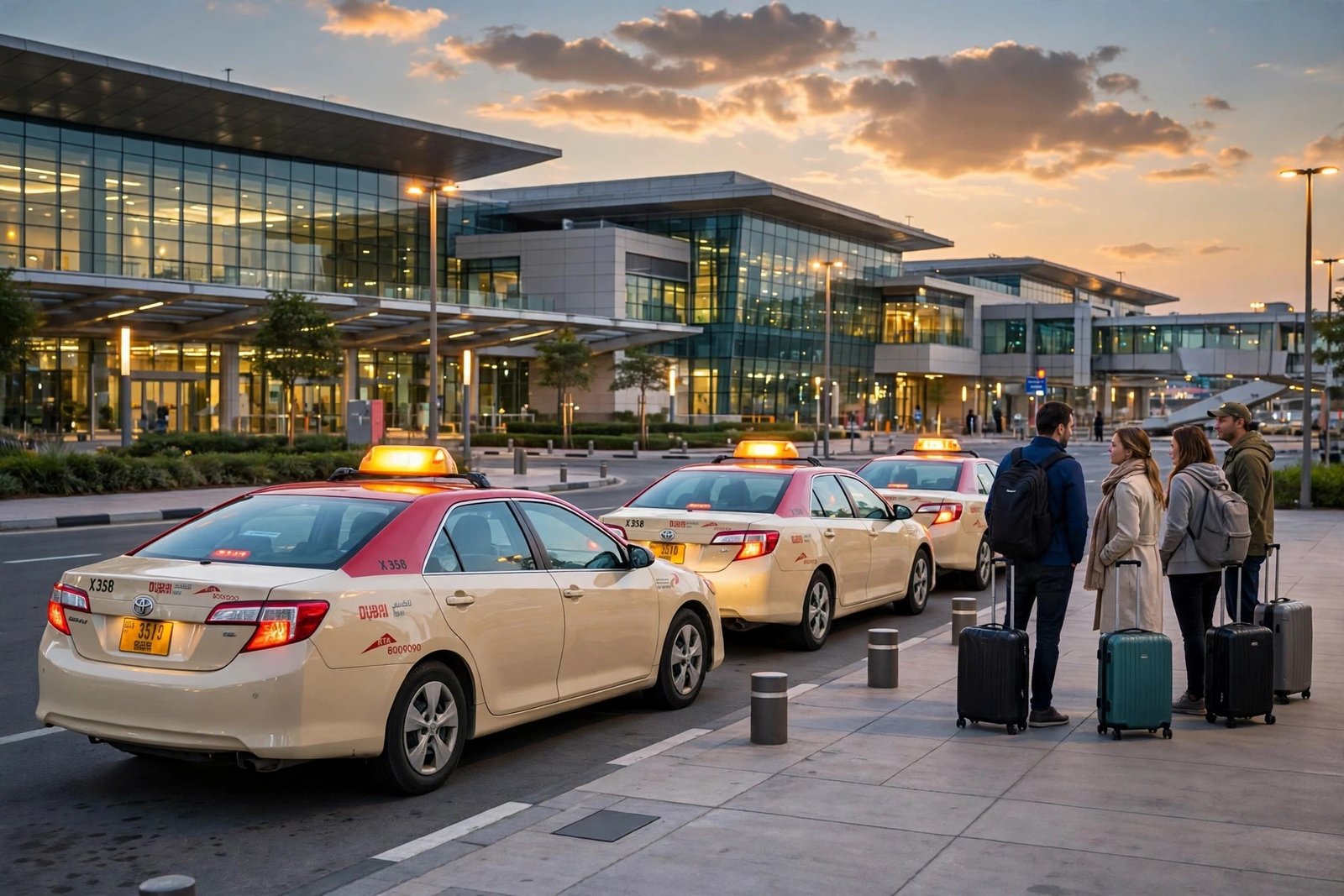
The bus gap, stated plainly: no direct RTA bus runs from DXB to Downtown or the Marina. What exists is the C01 — AED 5 for its route from Terminal 3 through Deira and Bur Dubai to Satwa — and it runs 24 hours, which matters because the metro does not. There is no metro service between midnight and 05:00 (08:00 on Sundays), so a 2am arrival leaves you the C01 or a taxi. For scale on app cars, the only figure Uber itself publishes for DXB is an average UberX fare of AED 119 for a 24-minute ride — an average across trips, not a tariff.
Transport is also the line that changes most if you move emirate: Abu Dhabi has no metro at all, and the intercity bus from Dubai costs AED 25 (RTA) before you have moved a metre inside the city. If you are weighing Dubai against Abu Dhabi or Sharjah, run the whole move — rent, food and this section’s rows — through our City Comparison Calculator.
Last updated: 23 October 2026
Sources: RTA Nol fares, card products and timetable pages (rta.ae); Dubai Taxi Company tariff pages (dubaitaxi.ae) and the Hala fare page (halaride.com); Salik tariff via the Dubai Government portal (dubai.ae), with the June 2026 VAT change as reported from Salik’s statement; Parkin tariffs as reported by Arabian Business, Lookinsure and Khaleej Times; UAE Fuel Price Committee prices for October 2026 (Gulf News, Khaleej Times, WAM); Gulf News’ itemisation of RTA licence-exchange fees; Lookinsure insurance and permit figures; YallaMotor’s Salik worked example; Welcome Pickups airport fare estimates, cross-checked against the DTC meter. Figures pulled 23 October 2026. The taxi per-kilometre rate is fuel-indexed and changes monthly, so every taxi total here is an October 2026 total. The worked monthly comparisons are scenarios built on the assumptions printed beside them, not measured averages.
Pingback: Weekend in Dubai (2026): What Two Days Out Cost