

Most three-city comparisons give you one index number per city and stop there. That hides the only thing that matters when you are choosing where to sign a lease: which lines of your budget actually change. This article prices the same single person — studio flat in each city’s budget area, public transport, groceries cooked at home — in Dubai, Abu Dhabi and Sharjah, line by line, from named sources pulled in October 2026. Then it adds the fourth column most comparisons miss: living in Sharjah and working in Dubai. Run your own salary and areas through our City Comparison Calculator.
Which city is cheapest to live in — Dubai, Abu Dhabi or Sharjah?
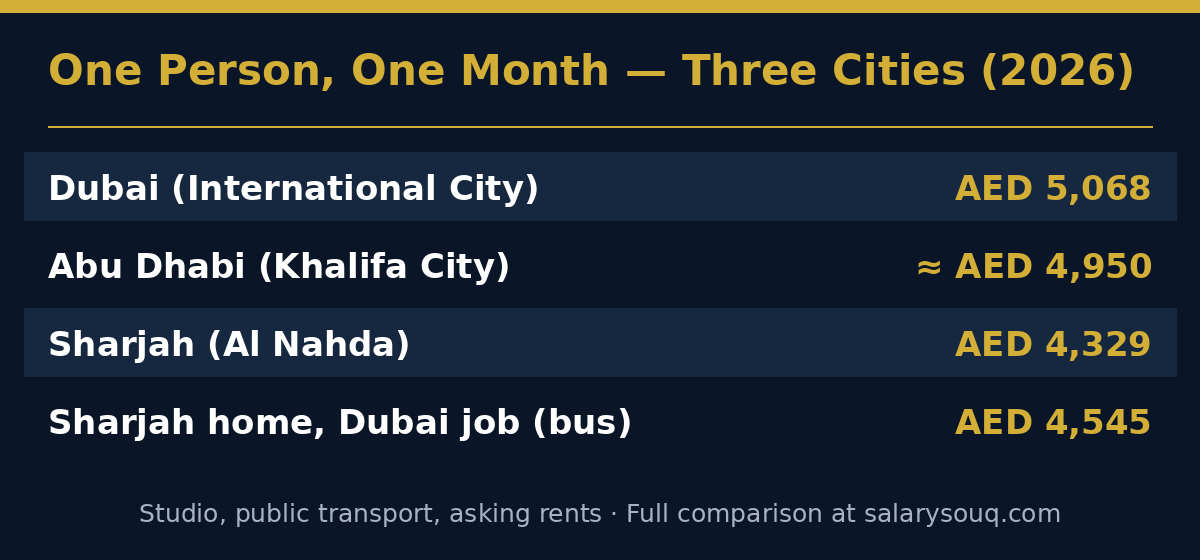
Sharjah — and by a wider margin than the studio headlines suggest. The worked core budgets in this guide total AED 5,068 a month in Dubai (International City), AED 4,943–4,958 in Abu Dhabi (Khalifa City), and AED 4,329 in Sharjah (Al Nahda). The fourth column — same Sharjah flat, but a Dubai job reached by intercity bus — totals AED 4,545, keeping AED 523 a month of the Sharjah saving.
| Line | Dubai (International City) | Abu Dhabi (Khalifa City) | Sharjah (Al Nahda) | Sharjah flat, Dubai job (bus) |
|---|---|---|---|---|
| Studio rent | 3,417 | 3,250 | 2,420 | 2,420 |
| Housing charge | 171 | 163 | 97 | 97 |
| Utilities | 250 | 350 | 500 | 500 |
| Food / groceries | 1,000 | 1,100 | 1,000 | 1,000 |
| Transport | 230 | 80–95 | 312 | 528 |
| Core total | 5,068 | 4,943–4,958 | 4,329 | 4,545 |
How each line was picked — because the picks are the honest part. Rents are asking rents throughout (the next section explains why that matters): AED 41,000 a year for the International City studio and AED 39,000 in Khalifa City, both Bayut H1 2026 averages, and AED 29,043 on Bayut’s Al Nahda (Sharjah) listings page. Food lines sit inside each city’s main published guide range — Property Finder’s AED 800–1,200 for Dubai, Driven Properties’ AED 800–1,500 for Abu Dhabi, Superb Attestation’s AED 800–1,200 for Sharjah. One caution on food: the UAE Ministry of Economy’s Essential Goods Prices Platform tracks the same chains — Carrefour, LuLu, Nesto — in all three cities, so the unit prices behind our Dubai staples basket (AED 209, priced item by item) are prices a shopper in Abu Dhabi or Sharjah sees at the same stores. No city-split average basket exists, so city grocery totals stay guide figures. The Dubai column’s full version, with telecom and leisure added, is in our cost of living in Dubai budgets.
Bills are the weakest-sourced lines in the table, and they are labelled that way. Neither ADDC nor SEWA publishes an official “typical bill”, so every figure is a named guide’s estimate: the Abu Dhabi line is a pick inside PSS Removals’ AED 300–400 budget range for a 1-bed, and the Sharjah line a pick inside Superb Attestation’s AED 350–650 for a single person. Sharjah’s own guide bands do not even agree on basis — CitiesInsider puts a SEWA studio at AED 300–500 while GoProfiled puts a two-bedroom at AED 300–600. Treat both cities’ utility lines as planning figures, not meter readings.
How do rents compare across the three cities?
At the budget end the studios are closer than the marketing suggests — AED 41,000 a year asking in Dubai’s International City, AED 39,000 in Abu Dhabi’s Khalifa City, AED 29,043 in Sharjah’s Al Nahda — and the real gap opens at one bedroom: AED 61,000 in International City and AED 59,000 in Khalifa City against AED 37,470 for an Al Nahda 1-bed on Bayut’s listings. A worker who needs the second room, not the studio, is where Sharjah pulls away.
Two disagreements sit inside the Abu Dhabi studio figure and both are worth knowing. MyBayut’s own area round-up says Khalifa City studios are “available for AED 32k”, below the Bayut H1 2026 average of 39,000; Property Finder’s Khalifa City page averages AED 45,000 — from a crawl roughly 265 days old, an older vintage than the H1 2026 report. And Abu Dhabi’s cheapest sourced area, Mohammed Bin Zayed City, averages AED 28,000 a year for a studio on Bayut (Property Finder’s median is 32,000) — Sharjah money, though far from the Corniche-side job centres and with no sourced commute cost in our research, so no budget here is built on it. At the other end, Al Reem Island asks AED 70,000 for a studio and AED 94,000 for a 1-bed: “Abu Dhabi” spans both.
The housing charge differs in structure, not just size. Dubai and Abu Dhabi both take 5% of the annual rent, collected monthly inside the utility bill — AED 171 a month on the International City studio through DEWA, AED 163 in Khalifa City through ADDC. Sharjah takes nothing monthly. Instead it charges a one-off attestation fee of 4% of the annual rent (minimum AED 500, plus an AED 100 form fee) when the contract is attested and again at each renewal — AED 1,162 a year on the Al Nahda studio, about AED 97 a month if you spread it, and the budget table above does exactly that. The full Dubai breakdown, area by area, is in our guide to rent in Dubai.
One honesty point that applies to every rent in this article. Dubai is the only one of the three cities with a published contract-based series: Property Finder puts the same International City studio at AED 32,000 a year on contracts including renewals, against Bayut’s AED 41,000 asking average — signed rents landing roughly a fifth below asking. No equivalent series was found for Abu Dhabi or Sharjah, so their figures here are asking-side only and likely sit above what a signed lease lands at. The comparison is asking against asking, which is fair — but no total in this article is “what you will pay”. Sharjah’s edge is also a moving one: Bayut’s October 2026 data shows all 15 top Sharjah rental areas up year-on-year, with Al Nahda studio rents up about 14% in the 2025 annual report. Today’s gap, not a permanent law.
How does transport compare without a metro in Abu Dhabi and Sharjah?
Start with the structural fact: neither Abu Dhabi nor Sharjah has a metro. Dubai’s Nol system (AED 3, 5 or 7.50 a journey by zones crossed; 30-day passes at AED 140, 230 and 350, all RTA prices) has no equivalent in either city — public transport there means buses and taxis, and the bus systems price very differently. Our full Dubai breakdown is in the transport in Dubai guide.
Abu Dhabi’s Hafilat buses charge AED 2 to board plus AED 0.05 per kilometre, capped at AED 5 a journey, with free transfers inside 60 minutes; the card itself costs AED 10. The monthly pass is where the sources split, and this article does not pick a winner: Property Finder, citing the transport authority, lists a monthly pass at AED 80, while multiple 2026 Hafilat guides list AED 95 — with AED 80 appearing in one of them as the subsidised rate for social-support beneficiaries. That is why the Abu Dhabi budget above carries transport as the range 80–95. Drivers in Abu Dhabi meet the Darb toll instead: AED 4 per bridge-gate crossing, charged only at peak (7–9am and 3–7pm, Monday to Saturday) on the original four gates, free off-peak and on Sundays. The daily and monthly caps were removed on 1 September 2025, and two newer gates charge 24/7 from May 2026 — but a commuter crossing two peak gates on 22 working days still pays AED 176 a month, against Salik’s AED 6.30 per peak crossing in Dubai. Abu Dhabi taxis are cheaper per kilometre than Dubai’s on the published tariffs too: AED 1.82/km against AED 2.45/km, from a AED 5 flagfall.
Sharjah’s Mowasalat buses charge a flat AED 8 cash or AED 6 with a Sayer card per journey — and no published monthly-pass price could be found, so the Sharjah budget’s AED 312 transport line is pay-as-you-go arithmetic (AED 6 × 2 journeys × 26 days), labelled as our calculation, not a pass price. Sharjah taxis start at AED 3 and run about AED 1.61/km on Property Finder’s tariff; guides disagree on the minimum fare (about AED 14 per Property Finder, AED 10 per dubizzle), and no official SRTA tariff page was found to settle it. Sharjah has no car toll at all — its road tolls apply to commercial trucks only — so a Sharjah resident pays tolls only on days they drive into Dubai. One line is identical in all three cities and never decides anything: petrol. Special 95 is a federal price — AED 4.28 a litre in October 2026 in Dubai, Abu Dhabi and Sharjah alike.
Is it worth living in Sharjah and working in Dubai?
On money alone, yes — the bus commuter keeps AED 523 of the AED 739 Sharjah saving while earning the Dubai wage. The rent saving is AED 997 a month (AED 3,417 against AED 2,420); the RTA intercity bus hands back AED 216 of it over the Sharjah-local transport line, at AED 12 one way on the Nol card — AED 528 a month across 22 working days. Sharjah’s own SRTA intercity buses cost more, AED 17 one way, AED 748 a month on the same arithmetic. Driving instead: fuel of AED 376.64 (about 50 km a day Al Nahda to Deira, 22 days, at the federal petrol price) plus the Al Mamzar Salik gate alone at AED 277.20 a month, peak both ways — a car-commuter core total of about AED 4,671, before parking, insurance, maintenance or the cost of owning the car at all. Every gate deeper into Dubai adds AED 6.30 per peak crossing.

The price that is not in dirhams is time, and here the sourcing runs out honestly. The E307 (Al Jubail to Deira City Centre, about 27 km) is timetabled at 30–45 minutes off-peak in route guides; no sourced peak-hour bus journey time exists in our research, so none is quoted — peak runs longer, by an amount nobody in our sources measured. For driving, Visa Bureau puts the Sharjah-to-Dubai run at 30–60 minutes each way for most working expats, which is 22–44 hours a month in transit across 22 working days. That — roughly a working week of hours — is the real cost of the AED 523.
The trade only works because the job stays a Dubai job, so one more honesty point: does the same job even pay the same in each city? There is no official answer. No regulator publishes an emirate-level pay differential, and the sources that do exist point in opposite directions — MoneyCompare.ae (October 2026) calls equivalent private-sector pay “broadly comparable” with a premium in Abu Dhabi oil, gas and government-linked roles; recruiter Accel HR’s 2026 guide says Abu Dhabi pay is often 5–10% higher; HSBC’s Expat Explorer 2024 has Dubai expats reporting slightly higher average earnings than Abu Dhabi’s. Three sources, three directions. That is why every budget in this article holds the salary constant: the cost side is where the evidence is.
Which city works best for a family?
The one with the cheapest school run — because for a family, school fees are a bigger differential than rent. Start with the only regulator-backed figure in this section: about 78% of Abu Dhabi’s private-school students are in schools whose average annual tuition is under AED 30,000 (ADEK inspection reporting, via Edarabia, across 185 ADEK-registered schools spanning AED 2,200–96,333 a year). Named Abu Dhabi schools sit far below Dubai’s centre of gravity — Abu Dhabi Indian School at about AED 8,895 a year, GIIS (CBSE) at about AED 12,595, typical smaller schools at AED 20,000–35,000.
Dubai’s fees are KHDA-regulated and, at the British mid-tier families most often target, heavy: an average British starting fee of AED 37,151 a year and mid-tier examples at AED 35,000–75,000 per child (DXB Schools Fees Index 2026, from KHDA fact sheets), against an Indian-curriculum average start of AED 10,836. Sharjah’s named CBSE schools undercut even that: Sharjah Indian School at AED 3,700–6,480 a year, Delhi Private School Sharjah at AED 12,200–16,520, GEMS Millennium Sharjah at AED 15,880–25,360, inside a guide-level overall range of about AED 7,000–52,000. Two cautions: Sharjah’s regulator, SPEA, publishes no emirate-wide average fee that we could find, so Sharjah’s figures are guide and listing data — and the claim that Sharjah fees run “20–40% below Dubai” is one guide’s characterisation, not a statistic.
Then the flat. A family needs the 1-bed or 2-bed, which is exactly where Sharjah’s rent gap is widest — AED 37,470 a year for an Al Nahda 1-bed against AED 59,000 in Khalifa City and AED 61,000 in International City — and family grocery guides point the same way (Sharjah family of four at AED 2,300–3,500 a month per Superb Attestation, against Dubai guide totals of AED 2,500–5,000), though no worked family budget exists for Abu Dhabi or Sharjah the way it does for Dubai. The verdict the data supports: Abu Dhabi sits between the two — schooling materially below Dubai’s British-curriculum weight, on ADEK’s own numbers, with no commute penalty for Abu Dhabi jobs. Sharjah wins the arithmetic outright, but a Sharjah family with Dubai jobs pays the commute described above, twice over if both parents work. Whichever way your family leans, put your actual salary and school shortlist into the City Comparison Calculator before you sign anything — at family scale, one school choice moves the total more than the city does.
Last updated: 23 October 2026
Sources: Bayut H1 2026 rental reports and Bayut area listings pages (Dubai, Abu Dhabi, Sharjah); Property Finder area pages and guides; RTA Nol fares and intercity bus fares; Abu Dhabi Mobility / Hafilat fares via Property Finder and 2026 Hafilat guides (monthly pass price conflicts across sources — carried as a range); Darb toll rules via Khaleej Times and AD Mobility reporting; SRTA / Mowasalat fares via DubiCars and Edarabia guides; UAE Ministry of Economy & Tourism Essential Goods Prices Platform (updated 8 October 2026); UAE Fuel Price Committee petrol prices for October 2026 (WAM, Gulf News, Khaleej Times); ADEK school data via Edarabia; DXB Schools Fees Index 2026 (KHDA fact sheets); Driven Properties, PSS Removals, Superb Attestation and Visa Bureau cost-of-living guides; MoneyCompare.ae and Accel HR Consulting 2026 salary guides; HSBC Expat Explorer 2024. Figures pulled 23 October 2026. Abu Dhabi and Sharjah rents are asking rents — no contract-based series was found for either city; utility “typical bills” for Abu Dhabi and Sharjah are named guides’ estimates, as neither ADDC nor SEWA publishes one.