
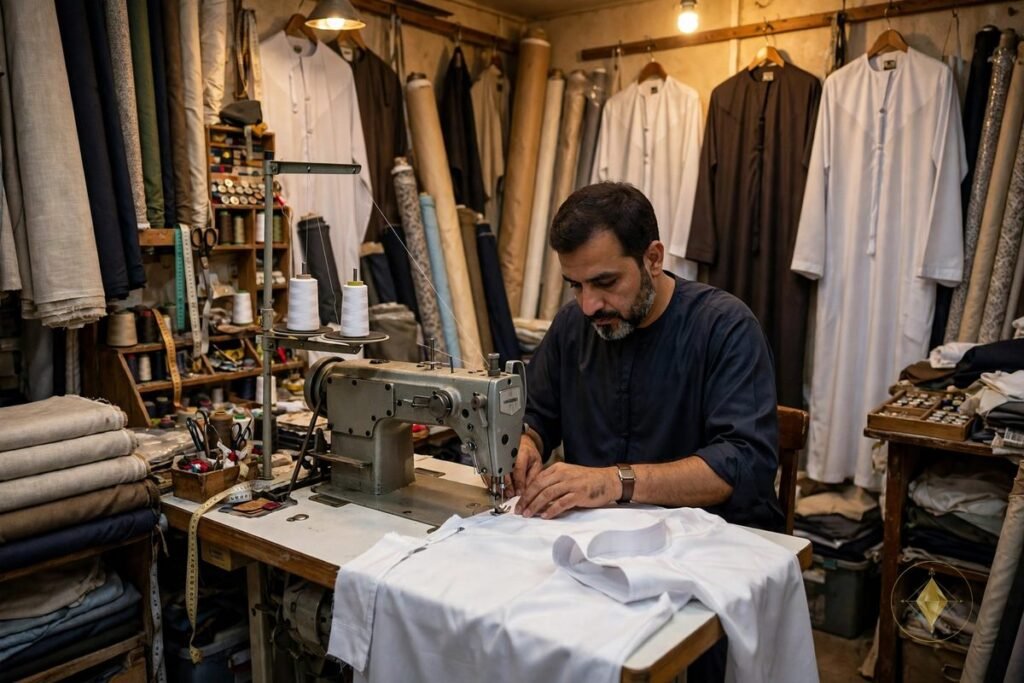
A tailor in the UAE earns between AED 1,403 and AED 4,472 per month (AED 16,836–53,664 per year), tax-free, on Indeed UAE’s salary page for the exact title “Tailor”: 485 salaries taken from job postings in the past 36 months, averaging AED 2,505 a month, updated 16 November 2026. No proxy is needed for this guide, because an exact-title board page exists. Jooble’s UAE-level average agrees closely at AED 2,573 a month, though it rests on only 8 salaries. The guides draw the shape of the market around that centre: ordinary shop tailors at AED 1,500–3,000 a month (SteadStaff), helpers near AED 1,200, and master cutters who can draft and cut a pattern, not only stitch one, priced from AED 2,500 to AED 6,000 and beyond depending on which guide you read. Piece-rate bonuses in the peak seasons sit on top of the basic the boards record, and they are not in the average.
One warning belongs with the headline. The guides in this market disagree at both ends by more than the board’s whole mid-band. At the entry step, one guide prices a helper at AED 1,200–1,600 a month and another prices a trainee at AED 1,800–2,500. At the top, a master cutter is priced at AED 2,500–4,000 by one guide and a master tailor or couture specialist at AED 5,000–10,000 by another. This guide prints the spread at both ends instead of picking the line that reads best, and it labels every band it assembles itself as built.
What is the average salary of a tailor in the UAE?
The short answer: AED 1,403–4,472 per month, averaging AED 2,505, on Indeed UAE’s Tailor page — 485 salaries from job postings in the past 36 months, updated 16 November 2026, and opened live for this guide on 22 November 2026. A search-index copy of the same page read on the same day showed AED 2,507 a month on 486 salaries. The AED 2 difference is a crawl-timing artefact between two copies of one page, and the live-opened figure is the one this guide uses. The page’s own cut for the largest city averages AED 2,670 a month on 288 salaries, with a range of AED 1,552–4,594, updated 8 November 2026 — AED 165 above the national average. Jooble’s UAE-level average of AED 2,573 a month sits AED 68 above the board average, close enough to confirm the centre, but it rests on 8 salaries against the board’s 485, so it is a cross-check and nothing more.
The summary table is built from the published figures named in each row’s basis. No board publishes an experience cut for the title “Tailor”, so the three experience rows are labelled built: they are assembled from the per-role ladders the guides do publish, and each row names the ladders it comes from. The separate roles are priced in their own rows, from their own guides.
| Level | Monthly salary (AED) | Yearly salary (AED) | Basis |
|---|---|---|---|
| Full headline range (Indeed Tailor page) | 1,403–4,472 | 16,836–53,664 | Indeed UAE’s Tailor page: typical range across 485 postings-based salaries; average 2,505 |
| Entry level (helper / trainee) — built | 1,200–2,500 | 14,400–30,000 | GPGC tailor helper 1,200–1,600; Recipmo helper or trainee 1,800–2,500; the two guides disagree and the row spans both |
| Skilled tailor (2–5 yrs) — built | 1,500–3,500 | 18,000–42,000 | SteadStaff UAE band 1,500–3,000; Recipmo general tailor 2,200–3,500; GPGC kandura tailor 1,500–2,800 |
| Master cutter / senior — built | 2,500–6,000 | 30,000–72,000 | GPGC master cutter 2,500–4,000; Recipmo master cutter or master tailor 4,000–6,000+; FindCompanyOffice prints 5,000–10,000 above this row |
| Kandura Tailor (separate role) | 1,500–3,500 | 18,000–42,000 | GPGC kandura tailor 1,500–2,800 plus piece-rate peak bonuses of 500–1,500; FindCompanyOffice kandura tailor 2,000–3,500 |
| Abaya Tailor (separate role) | 1,800–4,500 | 21,600–54,000 | GPGC abaya tailor 1,800–3,200; FindCompanyOffice abaya tailor 2,500–4,500 |
| Alteration Tailor (separate role) | 1,400–4,500 | 16,800–54,000 | GPGC alteration tailor 1,400–2,200; Recipmo alteration specialist 2,500–4,500 |
| Production Supervisor (separate role) | 3,500–6,000 | 42,000–72,000 | GPGC production supervisor 3,500–6,000, with long experience plus basic Arabic or English for customer handling |
Two cautions belong with the table. First, the company lines: the Tailor page’s own highest-paying table prints Royal Blinds LLC at AED 48,000 a year, which divides to AED 4,000 a month, and Safran at AED 42,000 a year, or AED 3,500 a month. The first is a blinds and curtains employer and the second an aviation group; their tailor postings are upholstery and interior roles, and neither line is typical pay for a tailoring shop. Second, the district lines: the same page prices Jumeirah at AED 3,226 a month, Al Barsha at AED 2,811 and Al Quoz at AED 2,670 for tailors — all at or above the national average of AED 2,505 — while its largest-city page prices Jebel Ali at AED 3,465, an industrial district where uniform and factory work concentrates.
What is the starting salary for a tailor with no experience in the UAE?
A tailor with no experience starts as a helper or trainee, and the guides price that step between AED 1,200 and AED 2,500 a month — the widest entry disagreement in this guide. GPGC prices a tailor helper at AED 1,200–1,600 a month and an alteration tailor at AED 1,400–2,200. FindCompanyOffice prices a tailoring helper or finisher at AED 1,200–1,800 and a garment worker sits at AED 1,200–1,800 on Equitrend. Recipmo prices the same step far higher: a tailoring helper or trainee at AED 1,800–2,500 and a sewing machine operator at AED 2,000–3,500. No guide puts a helper above AED 2,500, and two of the four put the floor at AED 1,200. A starting offer below AED 1,200 basic is below every floor in the retrieved evidence; a starting offer at AED 2,500 is at the top of the highest guide’s trainee band and should be checked for what it includes.
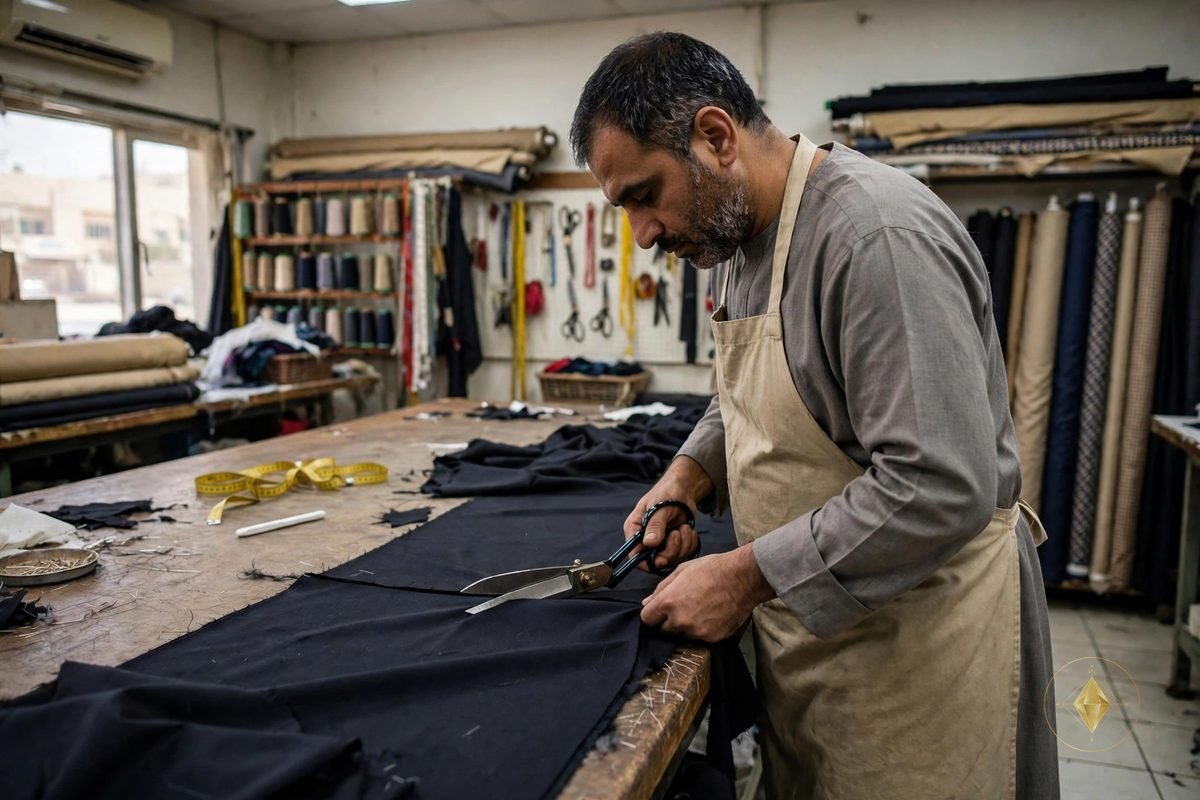
What a beginner should check before signing is not the headline figure but what sits beside it. FindCompanyOffice states that employers usually provide accommodation, transport and medical insurance, and Equitrend’s roles carry visa and accommodation included with monthly pay of AED 1,200–3,500. A helper offer of AED 1,400 with a bed, transport and a visa can leave more in hand than an offer of AED 1,800 with none of them, in a market where the worker pays for a shared room out of the salary. Ask for the basic, the accommodation, the transport and the piece-rate terms in writing, as separate lines, before you compare two starting offers.
The first skill step is worth real money and it arrives early. A helper who learns to run an industrial machine moves into the machine-operator bands — AED 1,500–2,500 on GPGC, AED 2,000–3,500 on Recipmo — and a tailor who can take measurements and finish a kandura end to end moves into the kandura bands of AED 1,500–2,800 on GPGC and AED 2,000–3,500 on FindCompanyOffice. SteadStaff’s guide adds the detail that decides hiring in this trade: the interview is a skill demonstration. A beginner with no UAE experience but a clean, fast demonstration on the machine is priced by what the demonstration shows, which is why the guides’ trainee bands are wide and why two beginners can start AED 800 a month apart in the same shop.
How much does a master tailor or cutter earn per month in the UAE?
A master tailor or cutter earns AED 2,500–4,000 a month on GPGC’s ladder, which prices both the pattern maker and the master cutter on that line — and the other guides price the same step higher, in a spread this guide prints in full rather than settling. Equitrend prices a master tailor at AED 2,500–3,500. The GujaratNews24 gig guide prices a master or specialist tailor at AED 3,000–4,000+. Recipmo’s current advertisements put ordinary tailoring positions at AED 2,000–3,500 and master-tailor or cutter offers reaching about AED 5,000–6,000, with its table pricing a master cutter or master tailor at AED 4,000–6,000+. FindCompanyOffice prices a pattern maker or cutter at AED 3,000–6,000 and a master tailor or couture specialist at AED 5,000–10,000 — the widest top in this pass, AED 4,000 above Recipmo’s ceiling and AED 6,000 above GPGC’s. SteadStaff, the recruiter guide, says the careful version: master tailors and cutters in high-end boutiques earn above its AED 1,500–3,000 UAE band, especially with a clientele for bespoke suits or bridal wear, without printing a ceiling at all.
The skill that earns the premium is cutting. Every ladder in this pack pays the same order: the worker who stitches a cut garment earns the general band, and the worker who can measure, draft the pattern and cut the cloth earns the master band, because a cutting error costs the shop the cloth and the customer. Recipmo prices the neighbouring specialist steps on the same logic: a bridal or couture tailor at AED 3,000–5,500+, an alteration specialist at AED 2,500–4,500, and a uniform-room tailor at AED 2,500–4,500. GPGC prices a production supervisor — the role above the master cutter in a factory or large shop, needing long experience plus basic Arabic or English for customer handling — at AED 3,500–6,000, and a fashion designer at the same AED 3,500–6,000. A master cutter in a large shop can therefore earn less than the supervisor line on one guide and more than it on another, which is another way of saying the title matters less than the shop.
Where the master works moves the figure as much as the title. Boutique and bespoke work in the largest city prices at the top of every guide, mall alteration counters and department stores in the middle (GPGC alteration tailor AED 1,400–2,200; FindCompanyOffice alteration tailor AED 1,800–3,000), and factory floors at steady but lower bands. Indeed’s district lines point the same way: Jumeirah, with its boutique trade, at AED 3,226 a month against a national average of AED 2,505. A master tailor weighing an offer should ask which segment the shop serves before asking what the band is, because the segment is what sets the band.
Do tailors in the UAE earn piece-rate pay on top of their basic salary?
Yes, in the traditional-garment segments — piece-rate pay on top of the basic is a standard part of kandura and abaya work, and the peak seasons are when it lands. GPGC prices it directly: kandura tailors earn AED 1,500–2,800 basic per month, with piece-rate bonuses during peak seasons that can add AED 500 to 1,500. Its guide names the seasons in the same text — Ramadan, Eid and wedding seasons — when every gents’ shop in the country is cutting kanduras against a deadline. Recipmo’s advertisements show the same structure from the employer’s side: a current listing at AED 2,700–3,000 a month plus incentives, with visa, medical insurance and annual leave, and home-service positions from about AED 3,500.
The size of the piece-rate top-up is priced for one segment only. No source publishes a single typical piece-rate figure for all tailors, and the guide does not invent one: factory tailors on GPGC’s uniform and machine-operator lines (AED 1,400–2,500) are priced as monthly basics with overtime, and boutique alteration work is priced as a monthly band on every guide. The Indeed average of AED 2,505 a month is a postings figure, and postings usually state the basic before piece-rate earnings; a kandura tailor in a peak month can therefore take home AED 500–1,500 above the figure his own posting advertised, and a tailor comparing a factory offer against a kandura-shop offer is comparing a fixed wage against a wage plus a seasonal variable. Ask how the piece rate is counted — per garment finished, per garment cut, or as a share of the shop’s peak-season billing — and in which months it has actually been paid.
Overtime is the second addition, and it is the one the factory segment relies on. Equitrend prices its tailor roles at 9–10 hours a day on shift and notes overtime at a premium on top of its AED 1,200–3,500 overall band. The premium itself is set by labour law rather than by the shop — basic plus 25% for overtime hours, rising to plus 50% for night hours — and the framework section below states it in full. A factory offer at the low end of a band with regular paid overtime can match a shop offer in the middle of the band with none, which is why the guides’ factory lines should never be compared on the basic alone.
What is the difference between a kandura tailor and an abaya tailor salary in the UAE?
The difference is small at the floor and grows at the top. GPGC prices a kandura tailor at AED 1,500–2,800 a month and an abaya tailor at AED 1,800–3,200 — the abaya band AED 300–400 higher at both ends. FindCompanyOffice prices the same pair higher and wider apart: a kandura tailor at AED 2,000–3,500 and an abaya tailor at AED 2,500–4,500, a gap of AED 500 at the floor and AED 1,000 at the ceiling. The two guides disagree on the levels but agree on the order: abaya work pays more than kandura work, because the abaya side adds embroidery and decorative finishing to the same measuring, cutting and stitching. GPGC prices an embroidery worker on its own line at AED 1,800–3,000, and FindCompanyOffice prices an embroidery machine operator at AED 1,800–3,000 — the skill that carries the abaya premium, priced the same by both guides.
The segments around the pair price in a clear order. A ladies tailor runs AED 1,600–2,800 on GPGC and AED 2,000–4,000 on FindCompanyOffice. A gents suit tailor — the bespoke end of the gents’ market — runs AED 1,800–3,200 on GPGC, above its own kandura line, because a fitted suit is the hardest garment in the gents’ shop. A curtain or upholstery tailor runs AED 2,000–3,500 on FindCompanyOffice, which is also the segment behind Indeed’s highest-paying company line: Royal Blinds LLC at AED 48,000 a year is a blinds and curtains employer. A uniform tailor, on factory contracts, runs AED 1,400–2,400 on GPGC — the steadiest work in the trade and the lowest band in it.
The hiring markets are separate, and a tailor’s band follows the segment he or she is hired into, not the trade as a whole. GPGC’s guide describes the map plainly: gents’ tailoring shops recruit kandura tailors, abaya boutiques and factories recruit abaya tailors, ladies’ boutiques recruit ladies’ tailors, and department stores and malls recruit alteration staff. A tailor who can cross segments — kandura cutting plus abaya embroidery, or bespoke suits plus alterations — is the worker the master bands are priced for. The neighbouring trades are covered in the Carpenter salary guide, the Painter salary guide and the Mason salary guide.
How much does a tailor earn in a garment factory compared with a boutique in the UAE?
A garment-factory tailor earns AED 1,400–2,500 a month on GPGC’s factory lines — a uniform tailor at AED 1,400–2,400 and an industrial machine operator at AED 1,500–2,500 — against a boutique tailor’s AED 2,500–4,000 at the ladies’ and gents’ end of Recipmo’s table, rising to AED 3,000–5,500+ for bridal or couture work. The factory pays less per month and pays it steadily: production runs all year, overtime is regular, and the supervisor ladder above the floor (AED 3,500–6,000 on GPGC) is a real promotion path inside one employer. The boutique pays more per month at the skilled end and swings with the seasons: the same shop that pays piece-rate bonuses of AED 500–1,500 in the Ramadan and Eid peaks has quiet months where the basic is the whole wage.
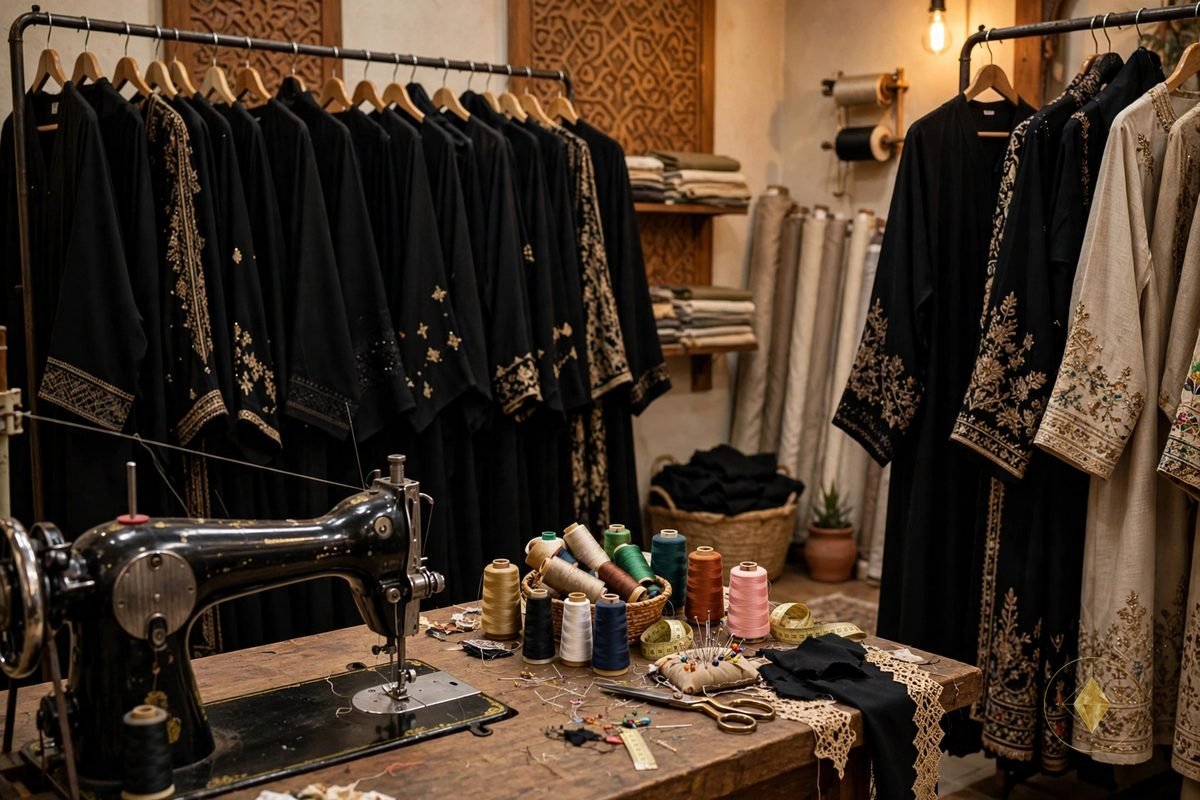
Indeed’s figures carry the same split in postings form. Its Tailor page averages AED 2,505 a month across every employer type, and its largest-city page prices Jebel Ali — the industrial district where the factories and uniform contractors sit — at AED 3,465 a month, the highest district line on that page, above Jumeirah at AED 3,226. That ordering surprises readers who expect the boutique district to top the table, and it is worth reading carefully: the Jebel Ali line averages the postings in that district, which include uniform-room and industrial employers advertising skilled-operator wages, while the national average is pulled down by small-shop postings. District lines on a postings board price the mix of jobs advertised there, not the wage of one named role, and this guide uses them for direction only.
The practical comparison for a tailor choosing between the two is total, not basic. Add to the factory basic the overtime the guide prices as regular, the accommodation and transport FindCompanyOffice names as usual, and the supervisor ladder. Add to the boutique basic the piece-rate peaks GPGC prices at AED 500–1,500, the commission-free months between them, and the master-cutter ceiling the boutique segment pays and the factory segment mostly does not. Neither total is published as one figure by any source, and the guide does not build one: it prints the parts, with their sources, and the parts are what an offer letter should be checked against, line by line.
Do tailoring shops in the UAE provide accommodation and a visa for tailors?
Yes, as a rule for overseas hires: FindCompanyOffice states that employers usually provide accommodation, transport and medical insurance for tailor roles, Equitrend’s tailor roles carry visa and accommodation included, and the GujaratNews24 gig guide lists accommodation and transport as common across its AED 1,500–4,000 bands. The visa is the employer’s sponsorship in every guide — a tailor does not arrive on a visit visa and convert it as a normal route, and any agent who prices the visa as a fee to the worker should be checked against the labour-law framework below.
The legal framework underneath every offer:
- No personal income tax. The figures in this guide are take-home before your own expenses. The full framework is in the UAE labour law guide.
- No legal minimum wage for private-sector workers. Pay is set by contract, skill and market. The floor in the retrieved evidence is AED 1,200, the low of the guides’ helper bands, and AED 1,403, the low of the Indeed range — both are market floors, not legal ones.
- Payment runs through the Wage Protection System (WPS). Private-sector salaries are transferred electronically under the WPS, so the figure in the contract is the figure that must arrive.
- Piece-rate pay and overtime are contractual, priced by law only at the overtime end. No law sets a piece rate; the kandura peak bonus of AED 500–1,500 is market practice and must be written into the contract. Overtime is paid at basic plus 25%, rising to plus 50% for hours between 10pm and 4am.
- End-of-service gratuity (Federal Decree-Law 33/2021). After one year of service, gratuity accrues at 21 days’ basic pay for each of the first five years and 30 days’ basic pay for each year after — calculated on basic pay only and capped at two years’ pay. Where piece-rate earnings form a large share of take-home, gratuity is smaller than total earnings suggest, so ask for the basic figure in writing.
- Visa and medical insurance come with the job for overseas hires. The employer sponsors the work visa and provides medical insurance as standard; the guides name both, plus accommodation and transport, as part of the usual package.
The way SalarySouq turns a stated monthly figure into yearly pay, gratuity and take-home estimates is set out on the How We Calculate Salaries page. The full index of guides is the Professions page, and the roles beside this one include the Electrician salary guide, the Salon Worker salary guide and the Housekeeper salary guide.
Frequently Asked Questions
What is the average salary of a tailor in the UAE?
AED 2,505 a month on Indeed UAE’s Tailor page — 485 salaries from job postings in the past 36 months, with a typical range of AED 1,403–4,472, updated 16 November 2026. The largest city’s page averages AED 2,670 a month on 288 salaries. Jooble’s UAE average of AED 2,573 a month agrees with the board but rests on 8 salaries. The guides price ordinary shop tailors at AED 1,500–3,000, with piece-rate bonuses on top of the basic in peak seasons.
What is the starting salary for a tailor with no experience in the UAE?
Between AED 1,200 and AED 2,500 a month as a helper or trainee — the guides disagree on this step more than on any other. GPGC prices a tailor helper at AED 1,200–1,600 and FindCompanyOffice a helper or finisher at AED 1,200–1,800, while Recipmo prices a helper or trainee at AED 1,800–2,500. Accommodation, transport, a visa and medical insurance are usually provided, so compare the package, not the basic alone.
How much does a master tailor or cutter earn per month in the UAE?
AED 2,500–4,000 a month on GPGC’s ladder for a pattern maker or master cutter, AED 4,000–6,000+ on Recipmo’s advertisement-based table, and AED 5,000–10,000 on FindCompanyOffice for a master tailor or couture specialist — a spread of AED 4,000 or more between guides, printed in full in this guide. SteadStaff prices master tailors and cutters in high-end boutiques above its AED 1,500–3,000 UAE band without printing a ceiling. The premium is for cutting and pattern drafting, tested at interview by a skill demonstration.
Do tailors in the UAE earn piece-rate pay on top of their basic salary?
Yes, in the traditional-garment segments. GPGC prices kandura piece-rate bonuses at AED 500–1,500 in the peak seasons — Ramadan, Eid and the wedding season — on top of a basic of AED 1,500–2,800. Recipmo’s advertisements show the same structure, with a listing at AED 2,700–3,000 a month plus incentives. No source publishes a single typical piece-rate figure for all tailors, and factory roles are priced as monthly basics with overtime instead.
Is AED 2,500 a month a good salary for a tailor in the UAE?
It sits almost exactly on the market’s centre: the Indeed average is AED 2,505 a month, and SteadStaff’s UAE band for tailors runs AED 1,500–3,000. As a basic for a skilled tailor with accommodation, transport, a visa and piece-rate earnings on top, it is a fair offer in the middle of the market. As a flat total for a master cutter — a role the guides price from AED 2,500 up to AED 6,000 and beyond — it is the floor, not a good offer. Compare the basic, the package and the piece-rate terms as separate lines.
Sources & methodology: Figures retrieved 22 November 2026 from Indeed UAE’s Tailor salary page at UAE level, opened live (average AED 2,505, typical range AED 1,403–4,472, based on 485 salaries from job postings in the past 36 months, updated 16 November 2026; district lines as printed: Jumeirah 3,226, Al Barsha 2,811, Al Quoz 2,670; top-paying companies as printed, per year: Royal Blinds LLC 48,000, Safran 42,000, Auriga International 40,800, Biri Group 39,000, Connect Resources 36,000, Marriott International 36,000 — the first two are upholstery and interior employers, not tailoring shops, and neither is presented as typical shop pay), a search-index copy of the same page read the same day (average AED 2,507 on 486 salaries — a crawl-timing difference of AED 2 against the live open, recorded as a disagreement), its largest-city Tailor page in search-result text (average AED 2,670, range AED 1,552–4,594, n=288, updated 8 November 2026; Jebel Ali 3,465, Jumeirah 3,226), Jooble’s Tailor page at UAE level in search-result text (average AED 2,573 a month, AED 30,876 a year, annual range AED 28,488–34,392, on 8 salaries, as of 4 November 2026 — used as a cross-check only), SteadStaff’s Tailor Jobs in the Gulf 2026 guide in search-result text (UAE tailors typically AED 1,500–3,000 a month; alteration tailors in the middle of the band; master tailors and cutters in high-end boutiques above AED 3,000; updated 21 October 2026), GPGC’s Tailor Jobs in UAE guide in search-result text (tailor helper AED 1,200–1,600; alteration tailor AED 1,400–2,200; uniform tailor AED 1,400–2,400; kandura tailor AED 1,500–2,800 with piece-rate peak bonuses of AED 500–1,500; gents suit tailor AED 1,800–3,200; ladies tailor AED 1,600–2,800; abaya tailor AED 1,800–3,200; embroidery worker AED 1,800–3,000; industrial machine operator AED 1,500–2,500; pattern maker AED 2,500–4,000; master cutter AED 2,500–4,000; fashion designer AED 3,500–6,000; production supervisor AED 3,500–6,000; the guide’s table header mislabels the currency as SAR while its text prices every role in AED, and the figures are used as AED as its text states), Equitrend’s tailor jobs guide in search-result text (overall AED 1,200–3,500 a month; tailor AED 1,500–2,200; garment worker AED 1,200–1,800; master tailor AED 2,500–3,500; 9–10 hour shifts; visa and stay included), Recipmo’s Tailor Jobs guide in search-result text (ordinary positions AED 2,000–3,500 in current advertisements; helper or trainee AED 1,800–2,500; sewing machine operator AED 2,000–3,500; general tailor AED 2,200–3,500; ladies or gents tailor AED 2,500–4,000; uniform-room tailor AED 2,500–4,500; alteration specialist AED 2,500–4,500; bridal or couture tailor AED 3,000–5,500+; master cutter or master tailor AED 4,000–6,000+; one listing at AED 2,700–3,000 plus incentives; the guide also cites an older Indeed largest-city average of AED 2,636 on 300 salaries updated 20 July 2026; its figures are labelled indicative market ranges, not guaranteed offers), FindCompanyOffice’s Tailor Jobs in UAE guide in search-result text (headline AED 1,200–10,000 a month; helper or finisher AED 1,200–1,800; embroidery machine operator AED 1,800–3,000; alteration tailor AED 1,800–3,000; gents tailor AED 2,000–3,500; kandura tailor AED 2,000–3,500; curtain or upholstery tailor AED 2,000–3,500; ladies tailor AED 2,000–4,000; abaya tailor AED 2,500–4,500; pattern maker or cutter AED 3,000–6,000; master tailor or couture specialist AED 5,000–10,000; accommodation, transport and medical insurance usually provided), and the GujaratNews24 gig guide in search-result text (typical pay AED 1,800–4,000; helper or alteration tailor AED 1,500–2,000; skilled tailor AED 2,000–3,000; master or specialist tailor AED 3,000–4,000+; accommodation and transport common; figures labelled indicative). An exact-title Indeed page exists for “Tailor”, so no proxy is used in this guide. No board publishes an experience cut for the title, so the three experience rows in the table are labelled built and are assembled from the per-role ladders named in each row. No PayScale, Naukrigulf, GulfTalent, Glassdoor or GrabJobs salary page for Tailor surfaced in search on 22 November 2026; all five are retrieval gaps, not proof the pages do not exist. No source publishes a single typical piece-rate figure for all tailors, and that gap is printed as not sourced. Excluded in full: Jooble’s largest-city Tailor average of AED 4,170 a month, which rests on 2 salaries as of 29 July 2026 and sits AED 1,500 above Indeed’s largest-city average on 288 salaries. Where the sources disagree — the entry step (GPGC’s helper at AED 1,200–1,600 against Recipmo’s trainee at AED 1,800–2,500); the master tier (GPGC at AED 2,500–4,000 against Recipmo at AED 4,000–6,000+ and FindCompanyOffice at AED 5,000–10,000); the kandura and abaya levels (both guides agree abaya pays more and disagree on every figure) — the disagreement is printed in the guide. Gratuity terms follow Federal Decree-Law 33/2021. SalarySouq’s conversion method is documented on the How We Calculate Salaries page.
Pingback: Customer Success Manager Salary in UAE 2026: AED 5,000–20,500/Month