
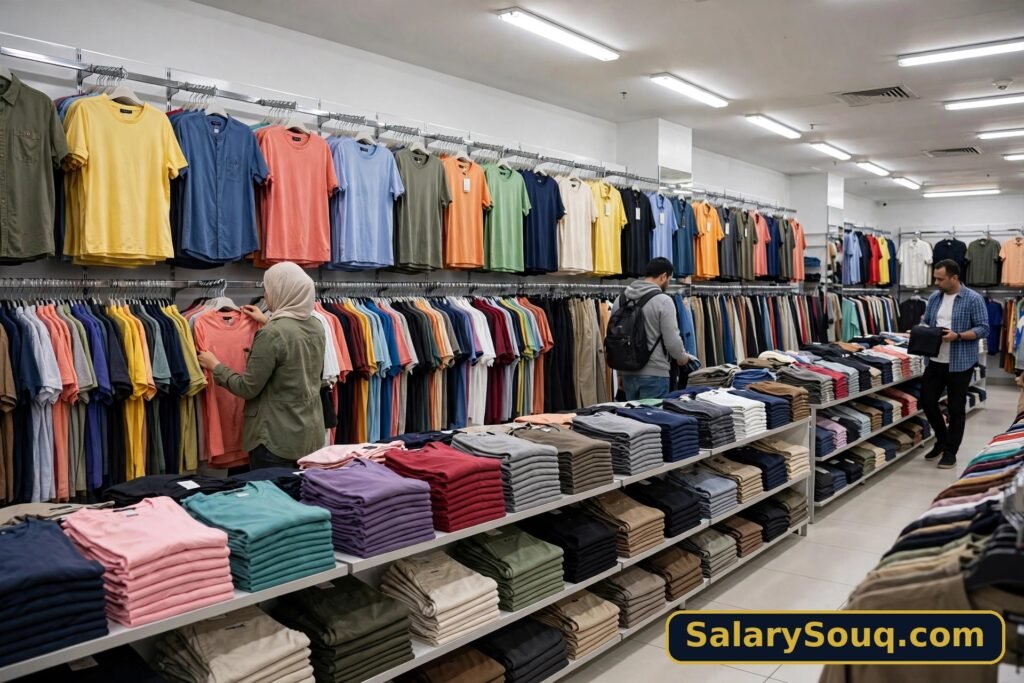
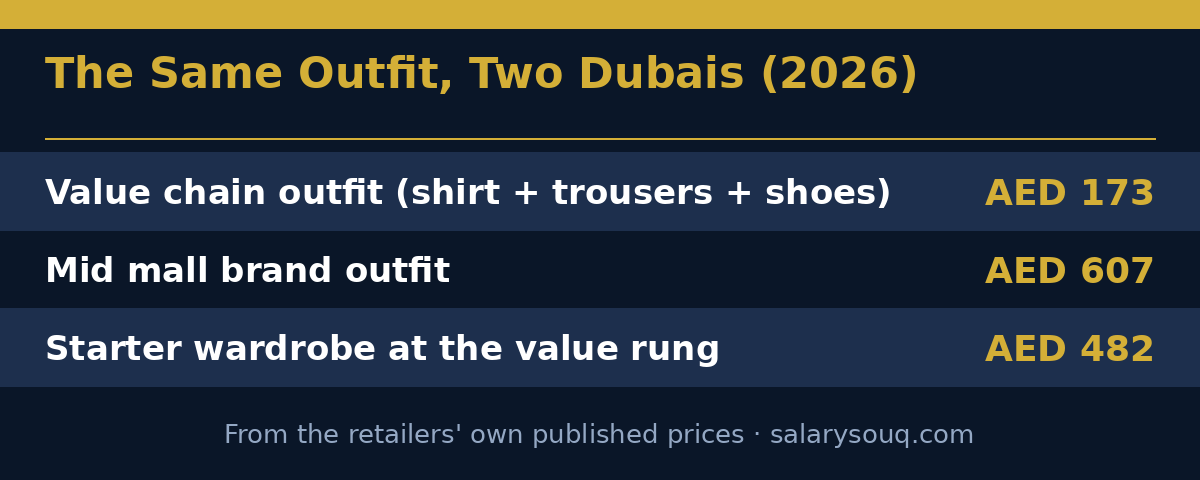
The same man’s outfit — a shirt, a pair of trousers, a pair of shoes — costs AED 173 at a value chain’s own listed prices and AED 607 at a mid mall brand’s, 3.5 times as much, sometimes under the same mall roof. Dubai clothing is not one market. It is two markets wearing one label, and which one you walk into decides the bill before you try anything on.
This article prices the basics rung by rung from the retailers’ own sites and October 2026 leaflets, pulled in October 2026: the value chains, the mid mall brands, the outlet and market tier, then the monthly toiletries-and-household basket that runs underneath the wardrobe, and the sales calendar that reprices all of it twice a year. Every price carries its channel — own site, marketplace listing, leaflet or guide — because a price without its channel is not comparable. Where no source publishes a figure, this article says so and quotes nothing. What these lines do to a whole month’s budget is worked through in our cost of living in Dubai budgets.
How much do basic clothes cost in Dubai?
At a value chain’s own prices, the full basic outfit costs AED 173: a flannel shirt at AED 49 and pants at AED 59 from Max Fashion’s men’s category page, plus its Flyknit trainers at AED 65. At a mid mall brand the same three slots cost AED 607 on Zara’s own site — Easy Care shirt AED 179, Basic Slim Fit Jeans AED 179, Penny Dress Loafers AED 249. Item by item:
| Item | Max (own site) | Zara (own site) |
|---|---|---|
| Shirt | Flannel shirt 49 (shirts on the page run 49–65) | Easy Care Textured Shirt 179 (shirts run to 249 for 100% linen) |
| Trousers | Pants 59 (pants and joggers run 49–65) | Basic Slim Fit Jeans 179 (straight-leg jeans run 199–349; chinos 179) |
| T-shirt | 15–27 (product pages — see the dating note below) | Basic Slim Fit T-shirt 65 (a striped tee is 49; medium-weight tees 99) |
| Shoes | Flyknit Lace-Up Sports Shoes (trainers) 65 | Penny Dress Loafers 249 (leather version 319) |
| Winter jacket | Puffer jacket 85 (jackets on the page run 85–149) | Check Padded Hoodie Jacket 399 |
Two honesty notes ride on this table. First, the shoes are not the same product: Max prices no formal or dress shoes on any page retrieved, so the value rung’s footwear is a pair of trainers — trainers are what a value chain sells at AED 65, and swapping in a formal shoe changes the comparison’s character, which is why the rungs stay separate. Second, branded footwear and leather business shoes have no own-site price in this research at all. The only reference points are crowd-sourced: Numbeo’s Dubai page puts mid-range Nike running shoes at AED 383.33 and men’s leather business shoes at AED 391.18, while its own UAE country page says AED 374.78 and AED 377.60 for the same items. A dataset that disagrees with itself is context, not evidence — those figures are labelled crowd-sourced guide data wherever they appear and feed no total in this article.
The dating note, because the two columns were not crawled the same way. Zara’s prices were pulled from its own site on 23 October 2026 — the freshest table here. Max’s category page and the trainers product page were crawled around 20 October 2026, equally fresh. But several Max product-page prices — the t-shirts at AED 15–27, printed shirts at AED 40, regular-fit shirts at AED 50–55, women’s sports shoes at AED 65–80 — rest on search-index crawls of those pages from February–March 2026. They are the same retailer’s own published prices from an older snapshot of its site, flagged as such wherever this article uses them, and they are the lines to re-check first.
Mall brands or the market — where is the same item cheaper?
Below the value chains sits a cheaper tier again — but the evidence changes character there. Dubai’s one outlet retailer with retrievable own-site prices, Up To You Outlet in Business Bay, lists men’s straight-fit jeans at AED 31.99 and graphic t-shirts at AED 32: two of the three outfit pieces for AED 63.99. The third piece does not exist in the evidence — the outlet prices no shoes on its retrieved pages, so the outlet outfit stays a two-item partial, the floor of the market rather than a like-for-like third rung. Outlet stock is end-of-line and rotates; these are listed prices on the crawl date, not a standing price list.
The souks are cheaper still, and unpriceable. Naif Souk, Baniyas, Karama and Dragon Mart are described by every guide as Dubai’s cheapest clothing tier, with bargaining expected — and no guide publishes fixed item prices for them, because prices there are negotiated stall by stall and no price lists exist online. The article can say the markets are the floor and that you haggle; it cannot put an AED figure on a market shirt, and does not. The same evidence wall surrounds three big names. REDTAG publishes no retrievable item prices on its own UAE store, so no REDTAG price is quoted. Brands For Less publishes no item prices either — the only figure attached to it is its own app claim of “up to 80% less than the retail price”, a retailer’s marketing claim, labelled as one, and not evidence of what anything costs. H&M’s own UAE site returned no retrievable item prices; the single H&M figure in this research is a marketplace listing — women’s Wide High Jeans at AED 95 (was AED 169) sold via Namshi — a marketplace price with a marketplace label, not an H&M own-site price.
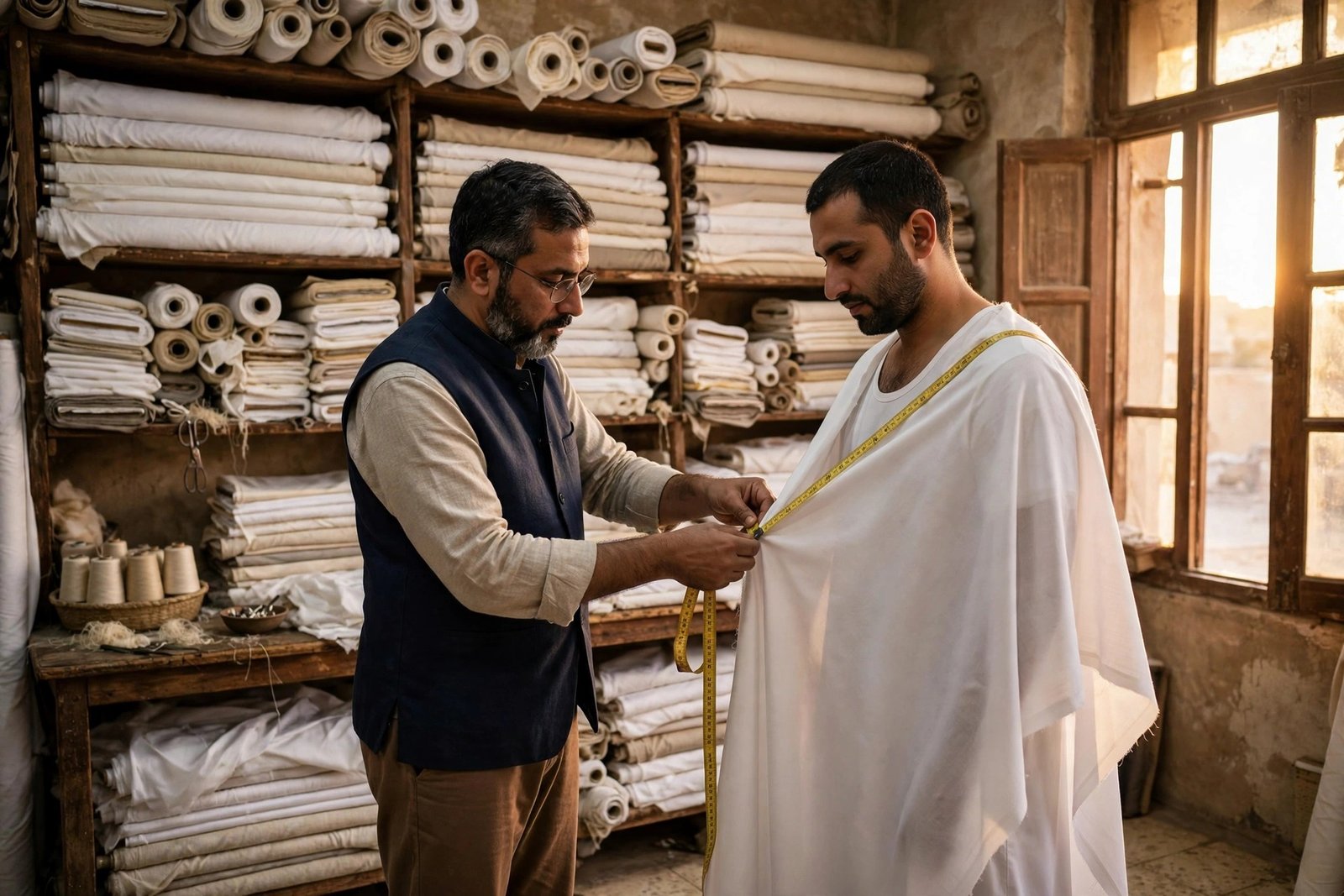
Traditional wear shows the same split between what is priced and what is not. A well-made tailored kandura has sat around AED 200–225 — but that figure comes from a National report from around 2020, dated colour rather than a verified 2026 price, and no current own-source tailoring price could be found. Against it, a ready-made round-neck thobe lists on noon at AED 26 (was AED 89) — a marketplace budget garment, a different product from a tailored kandura, and the two are presented as different products, never as a price range for one item. For abayas the guide floor is consistent: three guides agree that simple daily-wear abayas in Naif Souk start around AED 50, in a AED 50–150 range with bargaining expected, and embellished pieces run AED 200–500 on the same guide evidence. The priced top end is own-site: a CAS Basics designer black abaya at AED 430 and an ELLY Dubai abaya at AED 825. Quote only the souk floor and you hide the designer tier; quote only the designers and you hide where most abayas are actually bought.
What does a monthly essentials basket cost?
One person’s monthly toiletries-and-household core costs AED 83.54 at standard prices — and AED 42.46, 49% less, when each line is bought in its promo week. The basket is eight lines, each a stated monthly share of a real product priced in October 2026 leaflets: half a 355ml bottle of Hask shampoo; two bars of Dove soap; one 75ml tube of Colgate toothpaste; a third of a toothbrush (replaced every three months); half a 1.8L bottle of Persil detergent gel; half a 730ml bottle of Fairy dish liquid; four rolls of toilet paper; one box of facial tissues.
| Line (monthly share) | Standard (AED) | Promo (AED) |
|---|---|---|
| Shampoo — Hask 355ml, ½ bottle | 10.75 | 7.50 |
| Soap — Dove bar 160g, 2 bars | 22.25 | 8.25 |
| Toothpaste — Colgate 75ml, 1 tube | 7.50 | 2.25 |
| Toothbrush — Colgate, ⅓ of one | 1.61 | 0.83 |
| Laundry detergent — Persil gel 1.8L, ½ bottle | 19.00 | 10.00 |
| Dish liquid — Fairy 730ml, ½ bottle | 9.63 | 6.23 |
| Toilet paper — Carrefour Comfort XL, 4 rolls | 9.80 | 5.60 |
| Facial tissues — Everfine, 1 box | 3.00 | 1.80 |
| Total — monthly essentials core, one person | 83.54 | 42.46 |
This basket carries no ministry backing, and the reason matters. Readers of this site’s groceries research will know the UAE Ministry of Economy’s Essential Goods Prices Platform, which tracks supermarket prices item by item. That platform covers 33 items — food, water, fruit and vegetables only. It does not list shampoo, soap, toothpaste, detergent or tissues at all. A ministry price for toiletries does not exist; it is a gap in the official evidence, stated plainly. This basket is therefore built from a weaker tier: Carrefour, LuLu and Nesto leaflets from October 2026 (transcribed by the WowDeals catalogue aggregator) and Carrefour’s own online store, every price channel-labelled.
Two caveats ride on the totals themselves. The “standard” column is built from the leaflets’ struck-through “was” prices — and those are retailer claims, provably inconsistent ones: Nesto’s “was” for a 4 × 75ml toothpaste pack is AED 12.99 while Carrefour’s “was” for a comparable Colgate 4-pack is AED 28.99–29.99. Treat the standard column as “the leaflets’ own usual-price claims”, not as verified shelf prices. And the promo column mixes windows: the eight promotions ran in different leaflet windows across October 2026, so no single week offered all eight at once. AED 42.46 is the same basket bought line by line in each item’s promo week — how a leaflet-timing shopper actually achieves it across a month — not a single-transaction price. What the split does show is where timing pays: soap and detergent are the two largest standard-price lines (AED 22.25 + 19.00 = 41.25, about half the basket). The basket is a core, not a life: it excludes conditioner, shaving, skincare, cleaning sprays and bin bags — and for women readers one further line is sourced, an Always Maxi Thick 30-pack at was AED 21.50, promo AED 9.90 in LuLu’s Savers leaflet, named here rather than folded into a single-person total it was not built for. The food side of the monthly shop is a separate line again — a staples basket priced item by item in our groceries in Dubai guide — and the two baskets are kept separate, never merged into one “essentials” figure.
When do the big Dubai sales fall — and how much do prices actually drop?
The sales year has two festival poles, both run by one organiser, the Dubai Festivals and Retail Establishment (DFRE). The Dubai Shopping Festival’s 32nd edition runs 4 December 2026 to 17 January 2027 — 45 days, and it has not started yet. Dubai Summer Surprises ran 2 July to 30 August 2026. Between the poles, DFRE drops short 3 Day Super Sale windows around the religious holidays: a Ramadan edition on 12–15 March 2026 and an Eid Al Adha edition on 27–31 May 2026, that one extended from three days to five.
How deep the discounts run is where the evidence thins out — because DFRE publishes no official discount-depth figure for the Shopping Festival, and any line like “DSF means 70% off” would be unsourced. What the organiser does publish is a claim: “up to 90% off”, used in DFRE’s own promotion of its summer sale and Super Sale events. An “up to” figure describes the single deepest discount in the event, not the discount on the shirt in your hand, and it is quoted here as an organiser’s claim, every time. The priced evidence that actually exists today is everyday-sale evidence, and it is labelled as such: on Zara’s own site at crawl, a pair of Comfort Suit Trousers sat struck through from AED 249 to AED 139 (−44%), with two further items at −40% (AED 199 → 119 and AED 499 → 299) — ordinary October sale pricing, explicitly not Shopping Festival pricing, because the festival has not begun. In the October leaflets the same pattern runs deeper: Persil detergent gel struck from AED 37.99 to 20.00 (−47%), a Colgate 4-pack on Carrefour’s own site at −70% as listed. Real-world promo depth on priced lines therefore ran at roughly 30–70% off the retailers’ own struck-through prices in October 2026 — measured against “was” prices that are themselves retailer claims, as the basket section showed.
The calendar matters most to the new arrival buying a wardrobe in one go. Priced at Max’s standard listed prices, a starter wardrobe — 2 shirts, 3 t-shirts, 1 pants, 1 joggers, 1 sweatshirt, 1 puffer jacket, 1 pair of trainers — totals AED 482 (the shirts drop it to AED 469 under Max’s listed “2 FOR 85” shirt promotion). The same wardrobe brief priced at Zara’s own points comes to AED 1,579 — 3.3 times as much — with the substitutions named, because Zara offers no like-for-like for every slot: chinos stand in for the joggers, its Check Padded Hoodie Jacket stands in for the sweatshirt and jacket together, and its Penny loafers stand in for the trainers, no Zara trainer price having been retrieved. Two wardrobes for one job, priced AED 1,100 apart: that gap, not any festival percentage, is the number a new arrival’s first month turns on. Run the wardrobe and the basket against your own pay in the Savings Calculator before the festival banners talk you into the wrong rung.
Last updated: 23 October 2026
Sources: Retailers’ own sites — Max Fashion UAE (maxfashion.com/ae; category page and trainers crawled ~20 October 2026; several product-page prices rest on February–March 2026 crawls of the same site and are flagged in the text), Zara UAE (zara.com/ae, crawled 23 October 2026), Up To You Outlet (uptoyou.ae). October 2026 retailer leaflets — Carrefour, LuLu and Nesto — as transcribed by WowDeals, plus carrefouruae.com online; leaflet struck-through prices are the retailers’ own claims. Sales calendar: Dubai Festivals and Retail Establishment (DFRE) announcements; “up to 90% off” is the organiser’s claim. Marketplace listings, labelled wherever used: noon (ready-made thobe), Namshi (H&M jeans). Guides, labelled wherever used: AMO Fashion and hows.tech (abaya ranges), The National, ~2020 (tailored kandura — dated). Numbeo Dubai/UAE figures are crowd-sourced guide context only and feed no total. The UAE Ministry of Economy Essential Goods Prices Platform covers food, water and produce only — no toiletries figures are sourced from it. Figures pulled October 2026.