
Gold Prices in Dubai (2026): How a Gram Is Priced, Making Charges and the Real Cost
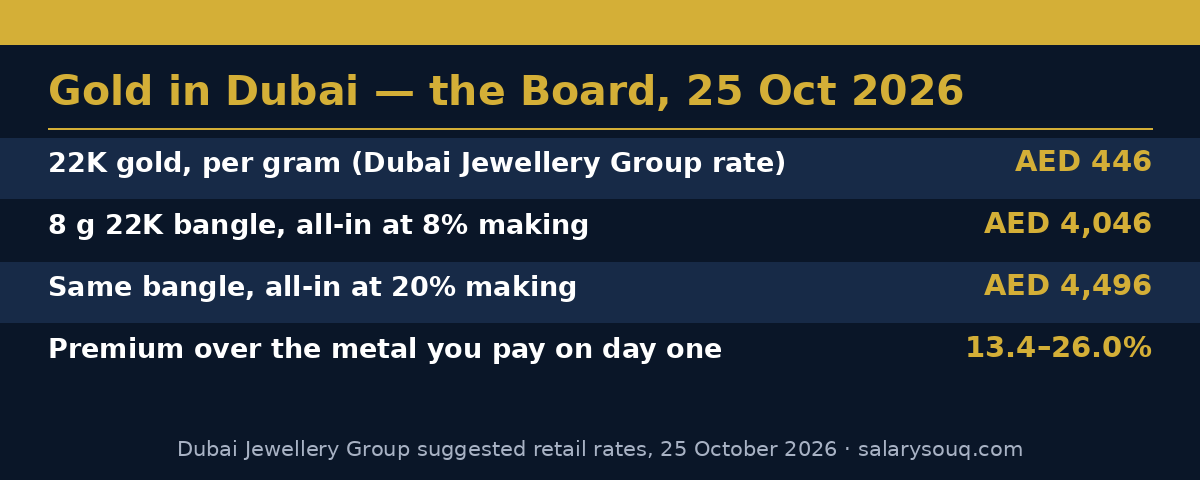
Walk into two gold shops in Deira on the same afternoon and the board behind both counters reads the same number: AED 446 for a gram of 22-karat gold. That was the Dubai Jewellery Group’s suggested retail rate on 25 October 2026, and no licensed shop in the city sells the metal itself above or below it. Yet the same 8-gram 22K bangle can leave one shop at AED 4,046 and another at AED 4,496 — a AED 450 gap on an identical weight of identical gold. The metal is not where the two bills part. The bill is built in three lines — metal, making charge, VAT — and only the middle line is the shop’s to set.
This article takes the bill apart line by line, at the rates published on 25 October 2026: how the per-gram rate is set and why it changes more than once a day, what making charges actually run on a plain chain or bangle, a worked all-in price for a small purchase with the VAT shown, and the question most buyers only ask years later — how much of what you pay is metal you can get back, and how much is gone the moment you leave the shop. The gold rate itself will have moved by the time you read this; the structure will not have. Any rate quoted without its date is not a price, it is a rumour, and this article dates every one it uses. What gold does to a monthly budget sits inside the wider cost of living in Dubai budgets — this piece stays on the gold itself.
How is the Dubai gold price set — per gram, by karat (24K, 22K, 21K, 18K)?
The rate is a per-gram price for each karat, published by the Dubai Jewellery Group — the trade body for the gold and jewellery business, set up in 1996 under Dubai Economy & Tourism — and followed by licensed retailers across the UAE. The board on the day this article’s figures were pulled, 25 October 2026:
| Karat | Purity | Rate (AED per gram, 25 Oct 2026) | What it is mostly sold as |
|---|---|---|---|
| 24K | 99.9% | 481.50 | Bars and coins — too soft for everyday jewellery |
| 22K | 91.7% (916) | 446.00 | The standard jewellery karat in the UAE |
| 21K | 87.5% (875) | 427.50 | Jewellery, common in regional designs |
| 18K | 75.0% (750) | 366.50 | Stone-set and diamond jewellery, which needs the harder alloy |
The karat is a purity share, and the prices are that share of the metal’s value: 22K carries 22 parts gold in 24, so its gram is priced at roughly 91.7% of the 24K gram. Nothing in that table is a shop’s opinion. The Group sets the board from the international gold price — quoted in US dollars per troy ounce — converted into dirhams at the fixed rate of 3.6725 dirhams to the dollar, and it updates the board more than once a day as the world price moves. (Sources pulled for this article disagree on whether the board is refreshed twice a day or four times; the honest statement is the one in the last sentence, and it is the one that matters at the counter, because a rate from this morning can be stale by the evening.)
Two consequences follow. First, the rate is the same in Abu Dhabi and Sharjah as in Deira — the Group’s rate applies across the licensed trade in all the emirates, so travelling across town does not find a cheaper gram, only a cheaper making charge. Second, the rate moves in money, not in fractions. In the six days before this article was written, the 24K board fell from AED 500.50 a gram on 19 October to AED 481.50 on 25 October. On a 10-gram purchase, that week was worth AED 190 of metal value — more than many making-charge negotiations win. Weight is quoted in grams, and in the unit many South Asian buyers still think in: one tola is 11.664 grams, so a tola of 22K held AED 5,202 of metal on 25 October. An 8-gram piece — the weight of the common gold coin and a light bangle — is a little over two-thirds of a tola.
One warning about rates you will see online. Pages that convert the live world spot price themselves showed slightly different figures on the same day — one carried 24K at AED 482.15 and 22K at AED 441.97 while the Group’s board read 481.50 and 446.00. Those are spot calculations, not the board the shop charges from. If the number on a website does not match the number on the board behind the counter, the board is the price; the website is the estimate.
What are making charges, and how much do they add on a simple chain or bangle?
The making charge is the shop’s charge for turning metal into a piece of jewellery — labour, design and finishing — and it is the only line on the bill the shop sets itself. It is quoted three ways: as a percentage of the gold value, as a fee per gram, or as a fixed amount on the piece. On a plain piece, at the ranges one Dubai bullion dealer publishes for Gold Souk counters, a simple bangle carries 8–12% and a machine-made chain 5–8%; handwork and stones push the same gram far higher:
| Piece | Typical making charge (share of the gold value) |
|---|---|
| Machine-made chains | 5–8% |
| Simple rings and bangles | 8–12% |
| Earrings (studs, drops) | 8–15% |
| Pendants with detail | 10–15% |
| Custom rings | 12–20% |
| Stone-set pieces | 15–25% |
| Bridal sets | 15–25% and above |
| Antique-finish and heritage designs | 20–40% |
Published guides frame the same charges differently, and the disagreement is worth showing rather than hiding. Policybazaar’s UAE pricing guide puts making charges at “about 15 to 25% of the total price” of a piece of jewellery; a general UAE gold guide puts plain items at 5–12%. Both can be true at once, because they are describing different counters. The souk end of the market — plain designs, high turnover, a customer who can walk ten steps to the next shop — prices its labour thin and expects to be haggled. The branded mall end prices it into the piece and holds the line. Guides that compare the two put souk making charges on plain designs at typically 5–8% and the big branded chains at 12–15% or more; treat those as the shape of the market, not a quote.
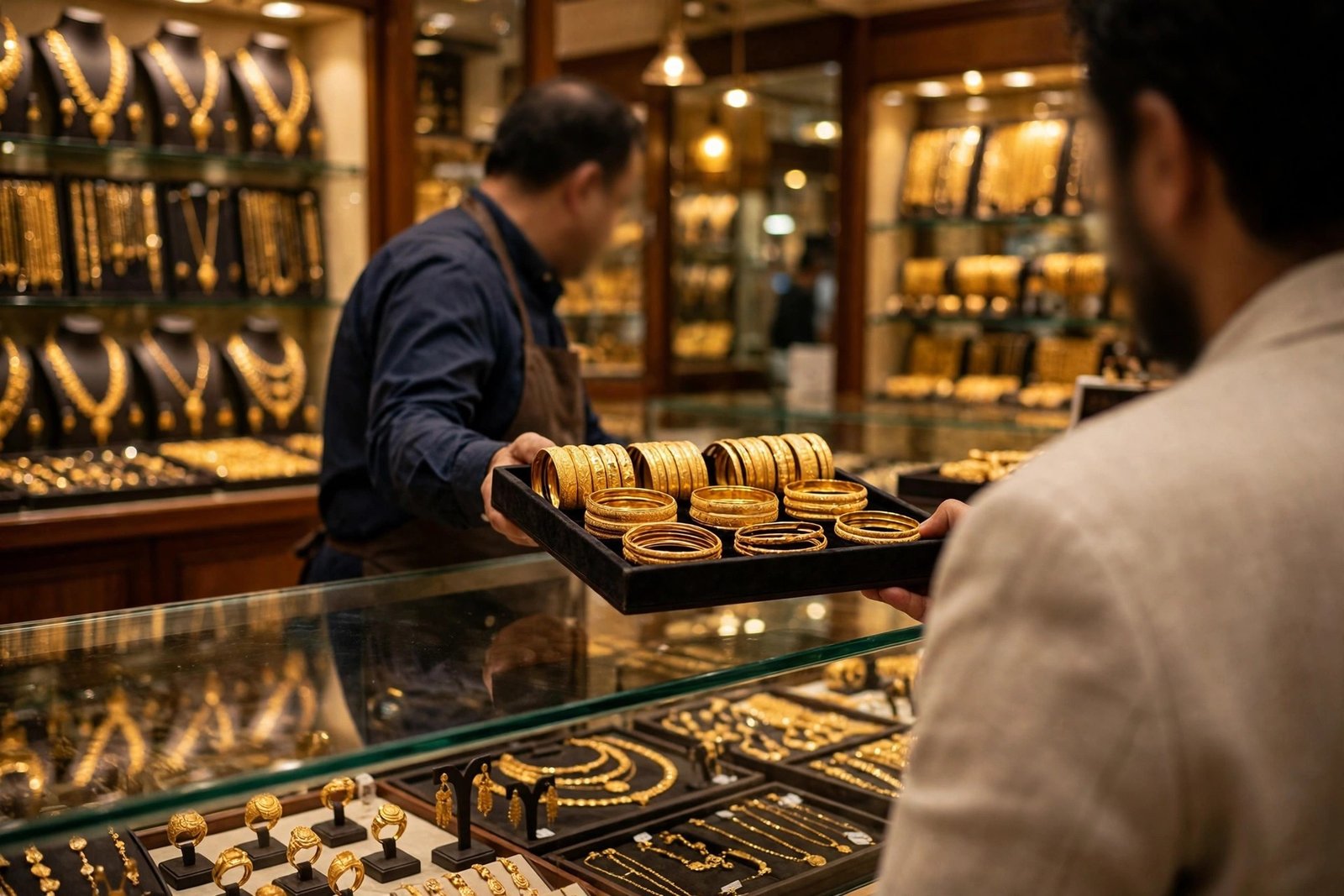
Two facts keep the haggling honest. At the souk, the making charge is the negotiation — the metal rate is not negotiable, and a shop that offers you a “discount on the gold rate” is taking it back somewhere else on the bill. At the branded chains, the charge is fixed by the price tag, and the movement comes in promotions instead: Malabar Gold & Diamonds, one of the largest chains in the UAE, has sold selected chains and bangles with making charges starting from 1.99%, and its festive offer running to 15 November 2026 takes up to 30% off making charges on gold jewellery. A promotion on the making charge is real money in a way a promotion on the metal can never be, because the metal was never the shop’s to discount.
What is the all-in cost of a small gold purchase — metal price, making charge, and VAT?
Take the purchase this article has been circling: a plain 8-gram, 22-karat bangle, bought on 25 October 2026 at the board rate of AED 446 a gram. The metal in it costs AED 3,568 wherever you buy it. Everything after that line is where the shops separate:
| Line on the bill | At 8% making (plain, souk end) | At 20% making (worked design, branded end) |
|---|---|---|
| Gold value — 8 g × AED 446.00 | 3,568.00 | 3,568.00 |
| Making charge | 285.44 | 713.60 |
| Subtotal | 3,853.44 | 4,281.60 |
| VAT at 5% | 192.67 | 214.08 |
| Total you pay | AED 4,046.11 | AED 4,495.68 |
The VAT line needs its own paragraph, because it is the one buyers most often hear wrong. A retail purchase of jewellery in the UAE carries 5% VAT on the full selling price — the gold value and the making charge together. The Federal Tax Authority has said this plainly: the tax reliefs in the gold trade, including the reverse-charge mechanism extended to precious metals between registered businesses from February 2025, apply to trade between dealers, and “retail sales of gold and diamonds are still fully subject to VAT at five per cent”. Guides claiming that VAT falls only on the making charge, or that gold in Dubai is simply tax-free, are describing rules that do not exist for a shopper. The one genuine exception sits in a different product entirely: supplies of investment-grade precious metal — 99% purity or higher, in bars and ingots that trade on the bullion market — are zero-rated. A 22K bangle at 91.7% purity is not that product and never becomes it. Tourists are the other exception of a sort: a visitor can reclaim the VAT on jewellery when leaving the UAE, through the tourist refund scheme, where the shop takes part and issues the tax-free tag. A resident cannot, which is why the same bangle genuinely costs a resident more than it costs the tourist standing next to them.
Read the two totals again, because they are the whole article in miniature. The dearer bangle holds exactly the same gold as the cheaper one. The AED 449.57 between them bought workmanship, a brand’s overheads and the tax on both — and not one extra milligram of metal.
Buying gold as savings: how much of what you pay is premium over the metal’s value?
On the worked example above, between 13.4% and 26.0% of what you pay is not metal. That premium — making charge plus the VAT on the whole bill — is the part of the price that exists only on the day you buy. When jewellery is sold, the buyer pays for the gold content at that day’s rate: the making charge is not recovered, and neither is the VAT. As one UAE gold buyer put it in Khaleej Times, sellers are generally paid for the gold content, not the design or the stones set in it. So the savings maths of a piece of jewellery is a break-even question: how far must the gold rate climb before the metal in your bangle is worth what you paid for the whole piece?
| At 8% making | At 20% making | |
|---|---|---|
| You paid | AED 4,046.11 | AED 4,495.68 |
| Metal you hold (25 Oct 2026 rate) | AED 3,568.00 | AED 3,568.00 |
| Gone on day one (making + VAT) | AED 478.11 | AED 927.68 |
| Gold rate rise needed just to break even | about 13.4% | about 26.0% |
Those break-even figures are the kind case. They assume the buyer on the day you sell pays the full metal value at the future rate with nothing deducted — and the rate displayed in a shop is its selling rate, not its buying rate for old gold, so deductions on resale are the normal case, not the rude one. Gulf News ran the same calculation on a larger piece and landed in the same place: at a 20% making charge, the gold value had to rise about 26% before the buyer recovered the full bill. The lesson is not that jewellery is a bad purchase. It is that jewellery is a purchase — something worn and gifted — carrying a savings component, and the savings component is only the metal line. Judge it on both, separately.
Three terms decide how much of the premium you can claw back, and all three should be asked about before you pay, not after. First, exchange is not cash. Chains advertise full value on exchange — Malabar’s published promise is 100% value on gold exchange, with zero deduction on exchange of 916 (22K) jewellery reported in its festive terms — but exchange value is credit towards another piece, and the new piece carries its own making charge and its own VAT. Cash buyback is a separate figure, usually a worse one, and published terms can apply a deduction to it that the exchange offer does not. Ask for both numbers, out loud, for the piece in your hand. Second, buyback promises belong to the shop that sold the piece — Malabar’s promises, in its own wording, are valid for jewellery purchased from Malabar. A receipt from another jeweller does not travel. Third, the invoice is the asset’s paperwork: without it, a future buyer re-tests and re-weighs on their terms, not yours.
If the aim is savings first and jewellery second, the metal itself is sold in a form built for it. Bars and coins carry no making charge in the jewellery sense — a coin or bar is priced at the board rate for its weight plus the shop’s premium for minting and retailing it, and that premium is the smallest spread in the shop. Malabar has sold its 8-gram gold coins with no making charges at all; at the 25 October rate, the metal in such a coin is AED 3,852. Be clear-eyed about the limit of that sentence, though: no standard published premium for bars and coins exists in the sources this article pulled, shops quote it per piece on the day, and small bars carry more premium per gram than large ones. The way to buy metal cheaply is not to find a shop with no premium — there is none — but to compare the same coin or bar, same weight, same day, across two or three counters, and pay the smallest number over the board rate. And the resident’s 5% point from the last section runs the other way here: jewellery attracts VAT at the till; a savings purchase in jewellery form starts 5% further behind before the making charge is even counted.
What does a purchase like this mean against a salary? The 8-gram bangle above, at AED 4,046 to 4,496 all-in, is roughly one full month of pay for a standard light-vehicle company driver in Dubai, whose band on this site’s figures runs AED 2,500–4,500 a month — see the driver salary in Dubai breakdown. That is the honest way to size a gold purchase: not against the board rate, but against the month it takes out of a pay cheque. Run your own version of that sum in the Savings Calculator before the festival season runs it for you — and price the rest of the celebration the same way, in our clothing and essentials guide.
What should the invoice show before you pay?
A proper invoice from a licensed Dubai gold dealer shows every line this article has used, separately: the gold weight in grams, the karat, the day’s rate per gram, the gold value those two produce, the making charge, any stone charges, the subtotal, the 5% VAT, and the total. Malabar’s published standard is the same idea on the price tag itself — total weight, stone weight and making charges spelled out before you buy, under what the chain calls its complete-transparency promise. If a counter quotes you one round figure and will not break it into those lines, the market gives you an easy remedy: Deira’s Gold Souk holds hundreds of licensed shops within a few minutes’ walk, and the next one will itemise. The two questions to ask at any counter, in this order: what is the making charge on this piece, as a number — and what would you pay me for it in cash today, and what would you credit me in exchange today. The gap between the answers is the true cost of owning the piece, and it is knowable before money moves, which is more than can be said for the gold rate itself.
Last updated: 25 October 2026
Sources
Rates: Dubai Jewellery Group’s own site, Dubai City of Gold (dubaicityofgold.com — “Today’s Suggested Retail Gold Jewellery Price”, 24K AED 481.50 · 22K 446.00 · 21K 427.50 · 18K 366.50 · 14K 285.75 per gram, pulled 25 October 2026), cross-checked the same day against GoldTrack UAE’s dated DGJG table (which also supplied the 19–25 October rate history and the 22K tola figure) and Gold Souk’s rate page; one spot-derived aggregator (goldratesindubai.com) showed different figures the same day and is flagged in the text wherever the difference matters. How the rate is set: BullionStar’s Dubai gold-market guide (the Group’s Retail Gold Rate and its update pattern), Economy Middle East’s gold-rate guide, and goldrateuae.live’s methodology notes. Making charges: Saqlain Bullion’s published Gold Souk making-charge table by piece type; Policybazaar UAE’s pricing-of-ornaments guide (the 15–25% framing); MarketsHost’s UAE gold guide for the souk-versus-branded comparison (a secondary guide, labelled as such in the text); Malabar Gold & Diamonds’ published terms — the Malabar Promise (itemised price tags, guaranteed buyback, 100% value on gold exchange), its 1.99% starting making charges on selected chains and bangles, and its festive offer of up to 30% off making charges to 15 November 2026, as reported by Khaleej Times, Dubai PR Network, Business News Chronicle and UAE News 24/7. VAT: the Federal Tax Authority’s clarification that retail sales of gold and diamonds remain fully subject to 5% VAT and that the reverse-charge mechanism (Cabinet Decision No. 127 of 2024, effective 26 February 2025) applies between registered businesses, as reported from the FTA statement; Gulf News, “Buying gold in the UAE: how making charges and VAT impact your profits when you sell jewellery” (the VAT-on-full-price statement, the exchange-versus-cash warning, and the break-even framework this article’s worked example follows); ClearTax’s UAE VAT-on-gold guide for the investment-grade definition; StashAway’s UAE gold guide for the tourist refund terms. Resale: Khaleej Times, “Selling old gold in UAE” (October 2026 — making charges not recovered, retail rate versus buying rate, sellers paid for gold content). Salary figures: SalarySouq’s own Driver Salary in Dubai article. All figures pulled 25 October 2026; the gold rate is republished by the Dubai Jewellery Group more than once a day and the rates in this article are the board of 25 October 2026, not a standing price.