
Last updated: 23 October 2026
Most cost-of-living guides give you one vague monthly number for Dubai. That is not much use when you are holding a job offer. What you need is a budget: rent, bills, food and transport added up line by line against an actual salary. This guide builds three of them — for a single person in a studio, on salaries of AED 5,000, AED 10,000 and AED 15,000 a month. Every figure comes from a named source, pulled in October 2026, and where sources disagree, the disagreement is shown rather than hidden.
What is the total monthly cost of living in Dubai in 2026?
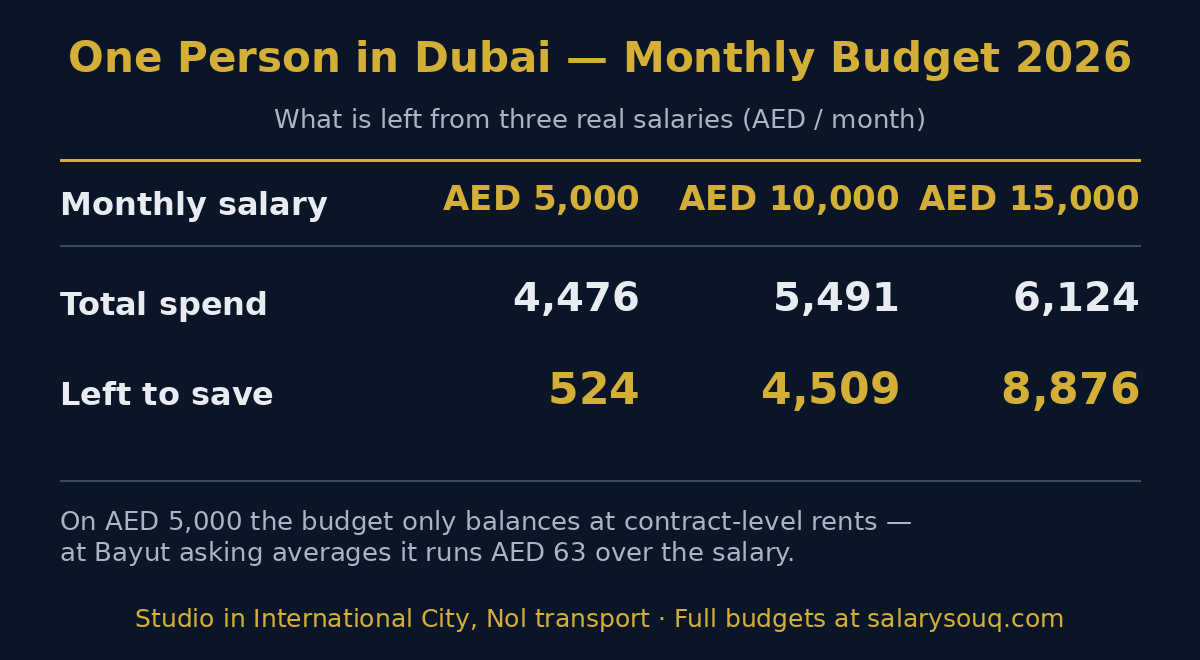
For one person living alone in a studio in International City, the worked budgets in this guide total AED 4,476 a month on a AED 5,000 salary, AED 5,491 on a AED 10,000 salary, and AED 6,124 on a AED 15,000 salary — leaving AED 524, AED 4,509 and AED 8,876 over respectively.
One honesty point before the detail, because it is the most useful finding in this guide. The AED 5,000 budget only balances at landlord-published and contract-level rents. The rent line uses the top of Dubai Residential’s (Nakheel’s leasing arm) published 2026 price list for International City studios, AED 34,300 a year. Run the identical budget at Bayut’s H1 2026 asking average for the same studio — AED 41,000 a year — and it totals AED 5,063 a month: AED 63 over the salary, before a single dirham of savings. At the two higher salaries the same studio at the asking average fits comfortably, which is why the AED 10,000 and AED 15,000 budgets below are built on it.
How much goes on rent, food, transport and bills each month?
Rent is the largest line at every salary level, followed by food. Here are the three budgets in full. Each line sits inside a published range from a named source; the sections after the tables give those ranges so you can re-run the numbers at the top or bottom of each one.
On a salary of AED 5,000 a month (studio at landlord-list rent, mobile only, no home internet):
| Line | AED/month | Basis |
|---|---|---|
| Rent — studio, International City | 2,858 | AED 34,300/year, top of Dubai Residential’s published 2026 price list |
| Housing fee | 143 | 5% of annual rent, billed monthly through DEWA |
| DEWA (electricity + water, incl. AC) | 250 | Inside Dubai Tool Kit’s studio range of AED 175–300/month |
| Food — groceries, cooking at home | 900 | Inside Property Finder’s single-person range of AED 800–1,200/month |
| Transport — Nol 30-day pass, 2 zones | 230 | RTA official price |
| Telecom — du prepaid (2 GB + 30 flexi minutes) | 49 | du prepaid plan listing |
| Leisure — 1 standard cinema ticket | 46 | VOX/Reel standard price, October 2026 |
| Health insurance | 0 | Employer must provide and pay for it by law |
| Total spend | 4,476 | |
| Left over | 524 (10.5% of salary) |
On a salary of AED 10,000 a month (same studio at the Bayut asking average, home internet added):
| Line | AED/month | Basis |
|---|---|---|
| Rent — studio, International City | 3,417 | AED 41,000/year, Bayut H1 2026 asking average |
| Housing fee | 171 | 5% of annual rent, billed monthly through DEWA |
| DEWA | 250 | Inside Dubai Tool Kit’s studio range of AED 175–300/month |
| Food — groceries | 1,000 | Inside Property Finder’s range of AED 800–1,200/month |
| Transport — Nol 30-day pass, 2 zones | 230 | RTA official price |
| Telecom — 5G home internet + prepaid mobile | 278 | AED 229 home wireless + AED 49 du prepaid |
| Leisure — budget gym + 1 cinema ticket | 145 | GymNation from AED 99/month + AED 46 cinema |
| Health insurance | 0 | Employer-provided by law |
| Total spend | 5,491 | |
| Left over | 4,509 (45.1% of salary) |
On a salary of AED 15,000 a month (same studio, fibre internet and postpaid mobile):
| Line | AED/month | Basis |
|---|---|---|
| Rent — studio, International City | 3,417 | AED 41,000/year, Bayut H1 2026 asking average |
| Housing fee | 171 | 5% of annual rent, billed monthly through DEWA |
| DEWA | 300 | Top of Dubai Tool Kit’s studio range — heavier AC use |
| Food — groceries | 1,200 | Top of Property Finder’s range of AED 800–1,200/month |
| Transport — Nol 30-day pass, 2 zones | 230 | RTA official price |
| Telecom — fibre internet + postpaid mobile | 514 | eLife Unlimited Starter AED 389 + du Power Plan 125 |
| Leisure — gym + 2 cinema tickets | 292 | AED 200 gym (inside GymNation’s AED 99–500 range) + 2 × AED 46 |
| Health insurance | 0 | Employer-provided by law |
| Total spend | 6,124 | |
| Left over | 8,876 (59.2% of salary) |
Rent. The studio figures come from our rent research: AED 41,000 a year asking average in International City (Bayut H1 2026), against AED 32,000 a year on Property Finder’s contract-based average and AED 31,200–34,300 on Dubai Residential’s own price list. The full area-by-area breakdown — including Al Nahda at AED 41,889 asking and JVC at AED 51,207 — is in our guide to rent in Dubai. On top of rent, budget for the housing fee: 5% of your annual rent, charged by Dubai Municipality and collected in monthly instalments inside your DEWA bill. It is AED 143–171 a month in these budgets and it is not optional.
Bills. DEWA publishes tariff slabs (electricity from AED 0.23/kWh for the first 2,000 kWh, per Property Finder’s DEWA calculator) but no official “average bill” — any typical-bill figure is a third-party estimate. Dubai Tool Kit puts a studio at AED 175–300 a month; seasonal guides split it further, with winter bills lower and summer bills higher (Casttio: studio AED 250–400 in winter, AED 400–600 at the summer peak). Air conditioning drives the gap: AC accounts for roughly 60–70% of summer electricity use. International City has no district cooling, so cooling lands on the DEWA bill rather than arriving as a separate charge.
Food. This is the softest set of numbers in the guide, and we are not going to pretend otherwise. Published guides put one person’s monthly groceries anywhere from AED 500 to AED 2,800: Commitbiz gives AED 500–900, Property Finder’s main cost-of-living guide gives AED 800–1,200, and Property Finder’s own relocation guide gives AED 1,200–2,800. The budgets above use the AED 800–1,200 range and place each salary inside it — if you eat out often rather than cooking, work from the top of the wider spread instead. For reference on unit prices, Gulf News’ grocery price dashboard (prices as of 8 October 2026, from ministry pack data) listed the lowest prices at AED 3.75 for a litre of fresh milk, AED 4.38 per kg for basmati rice and AED 11.31 per kg for fresh whole chicken. A budget cafeteria meal in the cheaper districts runs AED 15–40 (Where To Eat Dubai; Incorpyfy gives AED 15–30 for a local cafeteria meal).
Transport. The budgets assume no car. A Silver Nol card costs AED 3, 5 or 7.50 per journey depending on zones crossed (RTA tariff), and the 30-day pass used here — AED 230 for two zones, AED 140 for one zone, AED 350 for all zones — is an official RTA price. Note that monthly passes need a registered personal Nol card; an anonymous card can only hold the 7-day pass. If you drive instead, petrol is the easy part to price — Special 95 is AED 4.28 a litre for October 2026 (UAE Fuel Price Committee, reported by Gulf News, Khaleej Times and WAM) — but add Salik tolls (AED 6 per peak crossing, AED 4 off-peak on the Dubai Government portal’s tariff, plus 5% VAT on deductions since June 2026) before you compare it with the pass.
Telecom and the small lines. Entry mobile is cheap: du prepaid starts at AED 49 for 28 days and e& postpaid Freedom tiers start at AED 125 a month. Home internet is where headline prices mislead — both operators advertise “from” prices (du home from AED 272, e& home from AED 229) that are mostly promotions, usually excluding 5% VAT; the named entry fibre plan, e&’s eLife Unlimited Starter, is AED 389 a month standard. Leisure lines are deliberately small here: a standard cinema ticket was AED 46 at VOX and Reel on 23 October 2026 showtimes (elCinema), and budget gyms start from AED 99 a month (GymNation), with mid-range gyms typically AED 200–400.
Health insurance is AED 0 in all three budgets, correctly. Under Dubai’s Health Insurance Law (Law No. 11 of 2013), your employer must provide your health insurance and pay for it, and is not permitted to deduct the cost from your salary (Gulf News). It becomes your cost only when you sponsor dependants — which is where the family numbers below change.
What does a family of four spend per month in Dubai?
More than the single budgets plus a bigger flat — and the difference is driven less by rent than by school fees. The lines that change: a 2-bedroom in International City averages AED 66,880 a year (about AED 5,573 a month) asking on Bayut, AED 2,156 a month more than the studio, with the housing fee rising to AED 279. Two adults on Nol passes cost AED 460 a month. If your employer’s plan does not cover your family, insuring a spouse and two children at Essential Benefits Plan rates (AED 550–750 per person per year, per DHA reference pricing) adds roughly AED 138–188 a month.
Then come school fees, the swing cost. Per child per year, Indian-curriculum schools average a starting fee of AED 10,836, with mid-range schools at AED 21,000–23,747; British-curriculum schools average a starting fee of AED 37,151, with mid-tier schools at AED 35,000–75,000 (DXB Schools Fees Index 2026, from KHDA fact sheets). For two children, that is roughly AED 3,500–3,958 a month at mid-range Indian schools, or AED 5,833–12,500 a month at mid-tier British schools — more than the entire rent increase from a studio to a 2-bedroom, and at the British mid-tier, more than the rent itself. Two honest gaps: no named source publishes a family-of-four grocery total, so we have not scaled the single-person figure up; and no sourced 2-bedroom DEWA figure exists, so we have not estimated one. If you are comparing Dubai with Abu Dhabi or Sharjah for a family move, run the same salary through our City Comparison Calculator — for families, the school-fee and rent gaps between cities matter more than any other line.

How much can you realistically save on a AED 5,000, AED 10,000 or AED 15,000 salary?
On these budgets: AED 524 a month (10.5%) on a AED 5,000 salary, AED 4,509 (45.1%) on AED 10,000, and AED 8,876 (59.2%) on AED 15,000 — with the large caveat that the first figure only exists at landlord-list or contract-level rents.
Look at the pattern. The studio is the same in all three budgets; housing (rent + housing fee + DEWA) takes 65% of the AED 5,000 salary, 38% of the AED 10,000 salary and 26% of the AED 15,000 salary. Nothing about the flat changes — the salary rising is what makes it affordable. The standard rule of thumb (MyBayut) is to keep annual rent under 30% of salary: AED 18,000–36,000 a year at the AED 5,000 band, AED 36,000–54,000 at AED 10,000, and AED 54,000–90,000 at AED 15,000. The AED 15,000 budget is actually conservative — at that band, a JVC studio at AED 51,207 asking, or a 1-bedroom, also fits the rule, and choosing one would cut the leftover accordingly.
To place these salaries against real jobs, see what drivers earn in Dubai and what registered nurses earn, then run your own figures — your rent, your area, your food range — through the Savings Calculator. The honest answer at AED 5,000 is that saving is possible but thin, and it depends almost entirely on landing a studio at contract-level rent rather than the asking average; the usual alternative at that salary, a room in a shared flat, could not be included here because no named source in our research publishes a price for one.
Which costs surprise new arrivals the most?
Three, consistently: a tax hiding inside your electricity bill, a separate bill just for cooling, and how much cash you need before you get your keys.
The housing fee. New arrivals expect rent and DEWA. They do not expect Dubai Municipality’s 5%-of-annual-rent housing fee arriving inside the DEWA bill every month — AED 143 a month on the cheapest budget here, AED 171 on the others, every month of the contract. It is covered in detail in our rent in Dubai guide, along with the deposit and fee arithmetic.
Chiller bills. In towers with district cooling (Empower or Emicool), cooling is billed separately from both rent and DEWA, and in summer it is substantial. International City — the budget area used throughout this guide — has no district cooling, so its summer DEWA bills run 2–3 times non-summer levels instead (Dubai Property Insight). Either way, summer costs more; the surprise is not knowing which bill it lands on until you have signed. Check the building, not just the area, before you commit.
Move-in costs. The rent cheque is not the first money out. Before or at signing you will typically pay the Ejari registration (AED 177.75 done online through Dubai REST, AED 220 at a trustee centre — Dubai Land Department fee schedule), an agency commission where an agent is involved (typically 5% of annual rent), and the DEWA deposit (AED 2,000 for an apartment, AED 4,000 for a villa, plus AED 155 activation — DEWA fee schedule). On a AED 41,000-a-year studio, that is roughly AED 4,400 in one-off costs before your first month begins. None of it appears in the monthly budgets above, because it is not monthly — but it is exactly the money new arrivals forget to hold back.
Sources: Bayut H1 2026 rental report and Bayut listings data; Dubai Residential (dubairesidential.ae) published price lists 2026; Property Finder cost of living and DEWA calculator guides; Dubai Tool Kit utilities calculator; RTA Nol fares (rta.ae); UAE Fuel Price Committee prices for October 2026 (Gulf News, Khaleej Times, WAM); Gulf News grocery price dashboard (October 2026) and health insurance reporting; du and e& official plan pages; GymNation; elCinema showtime listings, 23 October 2026; DXB Schools Fees Index 2026 (KHDA fact sheets). Figures pulled 23 October 2026. Asking rents are advertised prices; where a figure comes from contracts or a landlord’s own price list, the text says so.
Pingback: Transport in Dubai (2026): Metro, Taxi and Car Costs
Pingback: Dubai vs Abu Dhabi vs Sharjah: Cost of Living 2026
Pingback: Cost of Clothing in Dubai (2026): What the Basics Cost
Pingback: Cost of Electronics in Dubai (2026): Phones & Laptops
Pingback: Gold Prices in Dubai (2026): Rates & Making Charges
Pingback: Gym Membership Costs in Dubai (2026): AED 99 to 1,950
Pingback: Entertainment Costs in Dubai (2026): Cinema & Days Out